
 By Weltrix
A clinical trial can fail for reasons that have nothing to do with the molecule, the device, or the protocol’s clinical logic – a sample size assumption from a small pilot that didn’t hold up at scale, or a Statistical Analysis Plan written to satisfy a checklist rather than answer the trial’s actual question. These failures are routine across submissions, regardless of therapeutic area or sponsor size.
A study can enroll on schedule and still arrive at database lock carrying a flaw baked in during protocol design months earlier. By the time a regulator flags an issue with multiplicity control or estimand definition, the cost of correction has multiplied – in money, time, and patient exposure.
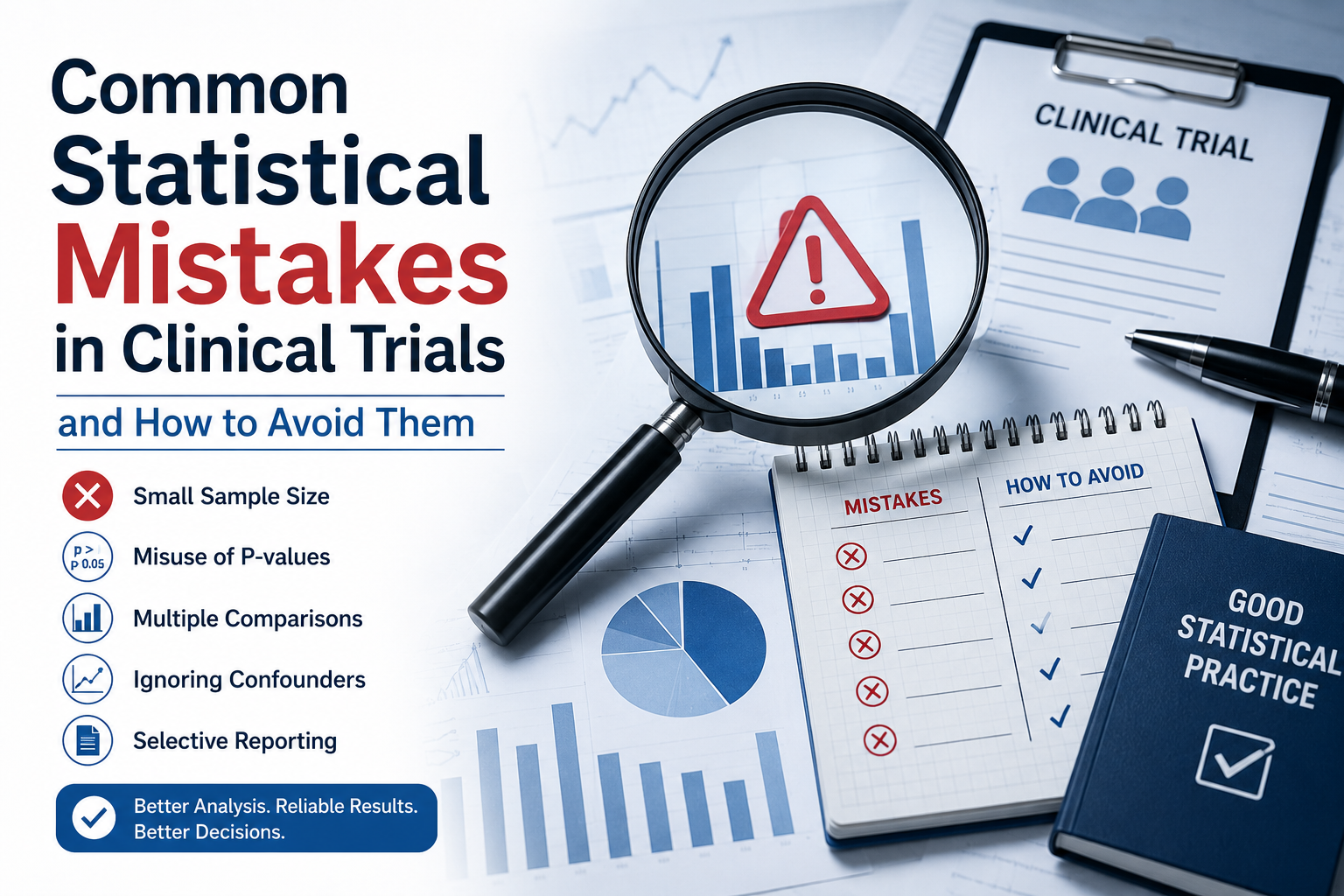
This guide covers the ten errors that recur most often across Phase II and Phase III programs, and what a disciplined sponsor, CRO, or investigator does differently to protect a trial’s statistical foundation.
Why Statistics Matter in Clinical Trials
Biostatistics shapes a trial from the start – how many patients are needed, how they’re allocated, what counts as a meaningful result, and how that result holds up under regulatory scrutiny.
A statistically sound trial answers three questions:
- Was the study powered to detect an effect that matters clinically, assuming one exists?
- Was the analysis pre-specified, executed without bias, and faithful to that pre-specification?
- Do the conclusions match what the evidence actually supports?
A “no” to any of these puts the program at risk, regardless of how clean the operational execution was. Gaps in statistical methodology rank among the most cited grounds for Complete Response Letters.
Top 10 Common Statistical Mistakes in Clinical Trials
1. Incorrect Sample Size Calculation
Underpowered studies are one of the most persistent problems in clinical research, often built on optimistic effect estimates or variance figures from a small pilot. An oversized trial is just as costly, burning budget and exposing more participants than necessary.
How to avoid it: Tie calculations to documented prior evidence, with biostatistician sign-off before the protocol locks, and run sensitivity analyses across a plausible range of assumptions.
2. Poor Randomization
Randomization neutralizes selection bias. Weak allocation concealment or missing stratification lets systematic differences creep into the comparison between arms before a single dose is given.
How to avoid it: Use a validated, audited system stratified by site and key baseline factors. Block randomization with concealed, varying block sizes is the working standard for most Phase II and III designs.
3. Inappropriate Endpoint Selection
An endpoint chosen poorly can’t be rescued later by clever analysis. If it isn’t clinically meaningful, reliably measurable, or regulator-accepted, the trial’s value is compromised regardless of the results. Surrogate endpoints carry particular risk – a significant biomarker shift doesn’t automatically mean clinical benefit.
How to avoid it: Select endpoints against current regulatory guidance and lock the operational definition – timepoints, responder thresholds, missing-data handling – before the protocol leaves draft form.
4. Ignoring Missing Data
Missing data happens in nearly every trial. The mistake is treating it as a nuisance instead of a mechanism worth understanding – complete-case analysis without examining why data is missing can introduce bias invisible in the topline result.
How to avoid it: Pre-specify the imputation approach in the SAP, backed by sensitivity analyses – multiple imputation, tipping-point analysis, delta-adjusted methods – that test whether conclusions hold under less favorable assumptions.
5. Multiple Testing Without Correction
Test enough hypotheses – endpoints, subgroups, timepoints – and the odds of a spurious finding climb fast. Twenty independent tests at a 5% threshold carry roughly a 64% chance of at least one false positive.
How to avoid it: Build a hierarchical testing strategy into the SAP that controls the familywise error rate or false discovery rate, using methods like Bonferroni or gatekeeping procedures suited to the hypothesis structure.
6. Misinterpreting P-Values
A p-value under 0.05 doesn’t mean a 95% chance the treatment works – it means a result this extreme would occur less than 5% of the time if the null hypothesis were true. Treating statistical as clinical significance is a common and costly misread.
How to avoid it: Always report p-values alongside effect sizes and 95% confidence intervals, and judge clinical relevance against a pre-defined minimally important clinical difference.
7. Poor Statistical Analysis Plan (SAP)
The Statistical Analysis Plan binds the trial to a pre-committed analysis approach. A vague or late-finalized SAP opens the door to selective reporting – undefined analysis populations, ambiguous deviation handling, imprecise endpoint definitions.
How to avoid it: Finalize and date-stamp the SAP before database lock, covering every analysis, model, covariate, and sensitivity analysis, aligned to the ICH E9(R1) estimands framework.
8. Lack of Data Validation
Even a well-designed SAP can’t compensate for unreliable source data. Weak edit checks and inconsistent entry conventions inject noise that propagates into final results.
How to avoid it: Build automated validation rules and CDISC-compliant SDTM datasets bridging the EDC system and statistical programming environment. Embed quality checks throughout the trial, not just at the end.
9. Ignoring Confounding Variables
Confounding distorts the apparent treatment-outcome relationship in both randomized and non-randomized designs, and smaller trials can carry baseline prognostic imbalances if the analysis doesn’t account for them.
How to avoid it: Decide covariates for the primary model based on clinical reasoning, not post-hoc data mining. For non-randomized work, plan propensity score matching or covariate adjustment during study design.
10. Regulatory Compliance Mistakes in Statistical Submissions
Statistical work must satisfy ICH E9, the E9(R1) estimands addendum, CDISC standards, and region-specific FDA or EMA requirements – falling short can mean a Complete Response Letter or months of delay. Strong regulatory compliance support closes this gap early rather than at submission.
How to avoid it: Train statistical programmers in current CDISC standards (SDTM, ADaM, DEFINE-XML 2.1), hold pre-submission meetings with regulators, and work with a partner experienced across multiple regulatory geographies.
Common Statistical Mistakes: Quick Reference Table
| Mistake | Primary Risk | Prevention Strategy |
|---|---|---|
| Incorrect sample size | Underpowered trial, false negatives | Evidence-based calculation, sensitivity analysis |
| Poor randomization | Selection bias, non-comparable arms | Stratified, concealed, validated randomization |
| Wrong endpoint | Regulatory rejection, irrelevant results | Regulator-aligned, pre-specified endpoint definitions |
| Ignoring missing data | Biased estimates, inflated significance | Pre-specified imputation strategy, sensitivity analyses |
| Multiple testing | Inflated Type I error, false positives | Hierarchical testing procedure in SAP |
| P-value misinterpretation | Overstated conclusions | Effect sizes + CIs, MICD-based interpretation |
| Weak SAP | Analytical flexibility, selective reporting | Finalized SAP before database lock |
| Poor data validation | Corrupted analysis datasets | Automated edit checks, CDISC-compliant CDM |
| Confounding variables | Biased treatment effect estimates | Pre-specified covariate adjustment models |
| Regulatory non-compliance | Submission delay, CRL | ICH/CDISC-compliant programming and documentation |
Best Practices to Avoid Statistical Mistakes in Clinical Trials
Design stage: bring a biostatistician into protocol development early, ground sample size calculations in documented assumptions, and define estimands under ICH E9(R1).
During the trial: run ongoing data quality monitoring rather than a single end-stage cleanup, use blinded statistical reviews before unblinding, and keep a living SAP amendment log.
Analysis stage: follow the SAP as written and document any deviation, run pre-specified sensitivity analyses, and use independent verification for pivotal analyses.
Submission: validate every ADaM dataset for reproducibility, ensure define.xml and the reviewer’s guide are complete, and run an internal mock regulatory review.
How a Biometrics CRO Helps Reduce Statistical Risk
Small and mid-sized biotechs often lack the in-house statistical depth a complex trial demands – exactly where a specialized biometrics CRO earns its place.
A capable biometrics partner brings:
- Therapeutic area depth – oncology, rare disease, and CNS trials each demand different models
- Regulatory fluency – FDA, EMA, and PMDA guidance shifts continuously
- Integrated functions – faster, fully traceable handoffs from clean data to analysis
- Programming depth – SAS and R fluency for CDISC-compliant ADaM datasets
Weltrix operates as an integrated biometrics CRO – clinical data management, biostatistics, and statistical programming under one accountable team, so sponsors aren’t stitching together vendors for interdependent functions.
Why Sponsors Choose Expert Biostatistics and Data Management Partners
The fallout from statistical errors in a pivotal trial shows up as delayed approvals, expensive resubmissions, and sometimes a program that doesn’t survive. Sponsors who bring in specialized expertise early tend to see regulatory-grade SAPs and protocols, faster database lock through validated workflows, reproducible deliverables, and biostatistics support that scales across phases without standing up a new in-house team each time.
Weltrix supports sponsors from initial power calculations through a regulatory-ready submission package.
Conclusion
Statistical mistakes in clinical trials are largely preventable when the right expertise shows up at the right stage and statistical planning is treated as binding rather than flexible. Each error covered here represents a point where an experienced biostatistician can change a program’s trajectory – and the statistical groundwork laid early determines how much weight every later conclusion can bear.
Work With Weltrix to Strengthen Your Clinical Trial Statistics
Weltrix delivers end-to-end biometrics and clinical data management for sponsors and CROs across therapeutic areas and geographies. If you’re planning a trial or need to shore up the statistical rigor of one already underway, get in touch with Weltrix.
Frequently Asked Questions
Q. What are the most common statistical mistakes in clinical trials?
Incorrect sample size calculation, inadequate missing-data handling, multiple testing without correction, p-value misinterpretation, weak SAPs, and non-compliance with CDISC and ICH standards.
Q. Why is sample size calculation so important in clinical trials?
It determines whether a trial has enough power to detect a clinically meaningful effect. An underpowered trial risks a false negative, so regulators expect a documented, evidence-based justification in the protocol and SAP.
Q. What is a Statistical Analysis Plan (SAP) in clinical trials?
The pre-specified document defining exactly how trial data will be analyzed – analysis populations, models, missing-data handling, multiplicity adjustments, sensitivity analyses – finalized before database lock.
Q. How does missing data affect clinical trial results?
It biases results when its mechanism isn’t accounted for – if dropouts differ systematically from completers, complete-case analysis will misrepresent the true treatment effect.
Q. What is the difference between statistical significance and clinical significance?
Statistical significance (p < 0.05) means a result is unlikely due to chance; clinical significance asks whether the effect size matters to patients. Large trials can reach significance on clinically trivial effects.
Q. What does a biometrics CRO do in clinical trials?
Provides integrated biostatistics, SAS/R programming, CDISC-compliant datasets, and regulatory submission support, without sponsors needing an in-house team for every trial.
Q. How can sponsors reduce statistical risk in clinical trials?
Engage biostatisticians early, build rigorous SAPs, use validated data systems, rely on CDISC-compliant datasets, and partner with an experienced biometrics CRO.
Q. What is biostatistics outsourcing and when should sponsors consider it?
Engaging an external partner for statistical design, analysis, and programming – worth it when in-house bandwidth is limited or regulatory-grade deliverables are needed on a tight timeline.
Key Takeaways
- Underpowered trials, caused by optimistic sample size assumptions, remain one of the most common and costly statistical errors.
- Weak randomization and allocation concealment can introduce selection bias before a trial even starts.
- Missing data needs a pre-specified imputation strategy, not a default complete-case approach.
- Uncorrected multiple testing can push the chance of a false positive above 60%.
- A finalized, date-stamped SAP completed before database lock is the strongest defense against selective reporting.
- CDISC-compliant data structures and ongoing validation reduce the risk of corrupted analysis datasets.
- An integrated biometrics partner reduces both statistical risk and submission timelines.
Leave A Comment