
 By Weltrix
You’ve signed with a full-service CRO. Six months in, your statistical programming lead has changed twice, your data management timeline has slipped behind your clinical timeline, and nobody on the biometrics side seems to know your protocol the way your medical monitor does.
This is not a staffing failure. It’s a structural one.
Full-service CROs are built to manage everything, including site selection, monitoring, regulatory affairs, biometrics, safety, and medical writing, under one umbrella for sponsors with the budget and the trial volume to absorb the inefficiencies that come with scale. Small and emerging biotech sponsors rarely have either. A single Phase II trial with a tight enrollment window doesn’t need a biometrics function buried three layers deep in a 10,000-person organization. It needs a team that treats biostatistics, data management, and statistical programming as the primary deliverable, not a cost center supporting twelve other departments.
That distinction is why a growing number of small biotech sponsors are outsourcing biometrics CRO services to specialized partners instead of folding them into a broader full-service contract. The choice of biometrics partner shapes database lock timelines, the cleanliness of submission-ready datasets, and ultimately whether a regulatory filing moves forward without a data query holding it up. For a company with one shot at a pivotal trial, that’s not a minor operational preference. It’s the difference between hitting a filing window and missing one.
Understanding the Difference Between Specialized Biometrics CROs and Full-Service CROs
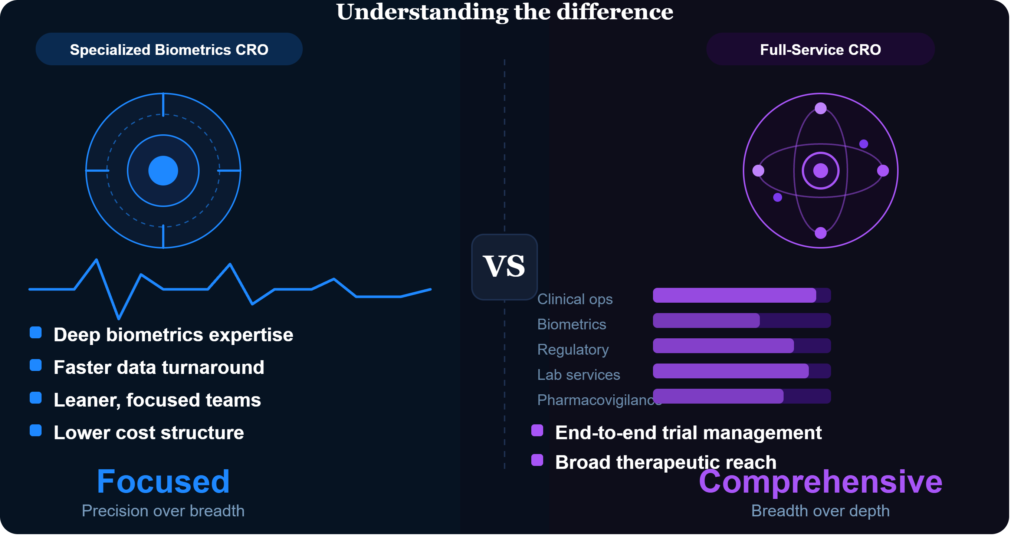
A clinical biometrics CRO focuses on a narrow, deep set of disciplines: biostatistics, statistical programming, clinical data management, and the regulatory deliverables tied to all three, such as SDTM and ADaM datasets, statistical analysis plans, define.xml packages, and submission-ready tables, listings, and figures (TLFs). That’s the whole business. There’s no monitoring division competing for the same project managers, no site-management group setting the priorities for the data team.
Full-service CROs operate differently by design. Biometrics sits alongside clinical operations, regulatory affairs, pharmacovigilance, and medical writing inside a single organizational structure, often with shared resourcing pools that get allocated based on which trial is loudest that week, not necessarily which trial is smallest or most schedule-sensitive. For a large pivotal trial with dozens of sites and a multi-year timeline, that structure can work fine. For a 60-patient Phase Ib study running on a 14-month runway, it often doesn’t.
This is part of why many biotech companies are reassessing the traditional one-vendor-does-everything model. The shift isn’t a rejection of full-service CROs outright, but a recognition that biometrics, as a discipline, performs better when it’s the primary function of the team handling it rather than one function among many.
Why Small Biotech Sponsors Prefer Specialized Biometrics CROs
Deep Expertise in Biometrics and Clinical Trial Data
When biostatistics, statistical programming, and data management are the entire scope of a team’s work, the people doing that work tend to have done a lot of it. Statistical programmers at an independent biometrics CRO aren’t rotating in from a different therapeutic area because the parent company needed coverage elsewhere; instead, they’re building SDTM and ADaM datasets and running the same category of analyses across multiple sponsors, which sharpens both consistency and speed.
That depth shows up in places sponsors don’t always anticipate: a programmer who’s mapped non-standard endpoints to CDISC structure dozens of times catches edge cases that a generalist team might flag only after a regulatory reviewer does.
Greater Flexibility and Personalized Support
Small sponsors don’t have the internal bandwidth to manage a layered vendor relationship. They need to talk to the person doing the work, not a project manager relaying questions to someone three tiers down. Specialized biometrics CROs tend to keep that line short, offering direct access to the biostatistician or lead programmer, faster turnaround on protocol amendments, and study designs that flex around the sponsor’s actual constraints rather than a templated service tier.
That responsiveness compounds over the life of a study. A two-day delay in resolving a data query means something very different to a sponsor running a single pivotal trial than it does to a CRO juggling forty.
Cost-Efficient Biometrics Outsourcing Services
Full-service CROs price in the overhead of departments a small sponsor will never touch. A specialized biometrics partner doesn’t carry that weight, meaning sponsors pay for biostatistics, data management, and statistical programming, not a proportional share of a monitoring division they’re not using. That difference matters most for companies trying to extend runway between funding rounds, where every line item in a CRO contract gets scrutinized.
It also means sponsors get access to senior-level biometrics expertise without the cost of building an internal team they’d need to staff, train, and retain on their own balance sheet.
Improved Regulatory Readiness
Submission-ready data is the deliverable that matters most, and it’s where specialization shows. ICH E6(R3), released in January 2025, reflects current approaches to clinical research including decentralized models, data governance, quality-by-design, and risk-based oversight, and biometrics teams are the ones translating those principles into actual datasets and documentation. The FDA formally adopted E6(R3) guidance on September 9, 2025, while the EMA’s Principles and Annex 1 took effect on July 23, 2025 across the EU, UK, and Switzerland, and Health Canada’s transition window runs through September 30, 2026. For sponsors running multi-region trials, that staggered timeline means biometrics deliverables need to satisfy whichever jurisdiction’s standard is strictest, not just the one closest to home.
A team whose entire function is biometrics tends to track that kind of regulatory movement more closely than a department competing for attention inside a larger CRO. CDISC-compliant datasets, audit trails, and define.xml packages aren’t an occasional deliverable for a specialized partner; they are the daily output.
Faster Clinical Trial Execution
Database lock is often the bottleneck standing between last-patient-out and a completed clinical study report. Specialized biometrics CROs streamline that workflow because there’s no competing priority pulling the data management team toward a different department’s deadline. Query resolution moves faster, edit checks get built earlier in the process, and the path from data lock to first-draft TLFs shortens, not because the work is rushed, but because nothing else is in front of it.
Key Benefits of Working with an Independent Biometrics CRO
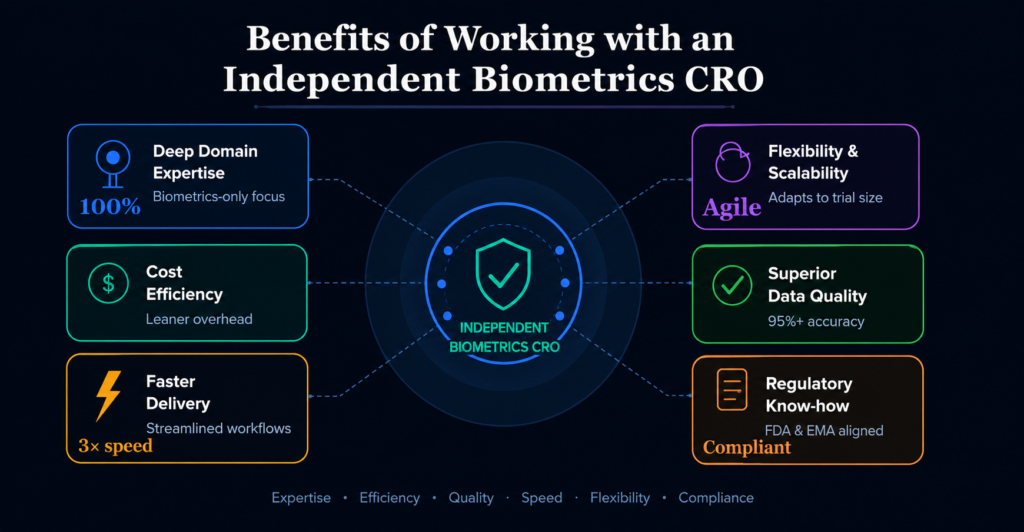
A few advantages tend to recur across sponsors who’ve made the switch:
- Dedicated biometrics leadership that reports directly to the sponsor, not up through layers of unrelated departments
- Transparent project management with visibility into timelines and resourcing decisions
- Scalability from first-in-human studies through Phase IV commitments, without re-contracting a new vendor at each phase
- A quality and compliance focus built around biometrics specifically, rather than applied uniformly across services that have very different risk profiles
When a Specialized Biometrics CRO Is the Better Choice
Not every sponsor needs to make this switch, and not every trial benefits from it. The fit tends to be clearest for early-stage biotech companies with limited internal infrastructure, who need biometrics expertise without building a department from scratch. It is also ideal for sponsors heading toward a regulatory submission, where dataset quality and CDISC compliance carry outsized weight.
Additionally, it benefits complex or data-intensive trials, such as adaptive designs, biomarker-heavy protocols, or studies with multiple endpoints, where statistical programming depth matters more than breadth of service. Finally, it serves organizations that want specialized expertise without absorbing the cost structure of a full-service contract built for larger trials.
Choosing the Right Clinical Biometrics CRO Partner
Picking a biometrics partner is its own diligence exercise, separate from picking a CRO in general. A few criteria worth weighing include experience across the therapeutic area in question, given that biometrics expertise in oncology doesn’t transfer cleanly to rare disease or medical device trials. Sponsors should also look for demonstrated regulatory and CDISC expertise, meaning not just familiarity with the standards but a track record of submissions that cleared review without major data queries.
Furthermore, you need a track record specific to biometrics, not a general CRO résumé with biometrics listed as one of many capabilities. Finally, look for quality systems and communication processes that match how the sponsor actually works. If direct access to the biostatistics lead matters, that needs to be confirmed before signing, not assumed.
Weltrix, a clinical biometrics CRO based in Morrisville, North Carolina, structures its model around exactly this kind of focus: biostatistics, statistical programming, clinical data management, and regulatory affairs support, without the layered overhead of a full-service contract. For sponsors evaluating whether a specialized partner fits their next study, that focus is usually the first thing worth testing in a conversation, before any contract gets discussed.
FAQ
Q. What is the difference between a biometrics CRO and a full-service CRO?
A biometrics CRO focuses exclusively on biostatistics, statistical programming, and clinical data management, while a full-service CRO bundles biometrics alongside clinical operations, monitoring, regulatory affairs, and other functions under one contract. The specialized model dedicates its entire resourcing to data quality and regulatory deliverables, while the full-service model allocates biometrics resources across a broader range of services.
Q. Why are small biotech sponsors moving away from full-service CROs for biometrics?
Small biotech sponsors often find that biometrics functions inside large full-service CROs compete for resources with other departments, leading to slower query resolution, less direct access to senior staff, and pricing that includes overhead for services the sponsor doesn’t use. Specialized biometrics CROs address each of these by structuring their entire business around biostatistics, programming, and data management.
Q. Is outsourcing biometrics to a specialized CRO more cost-effective than building an internal team?
Yes, for most small and emerging biotech sponsors. Building an internal biometrics function requires hiring, training, and retaining biostatisticians and programmers, along with the technology infrastructure to support CDISC-compliant deliverables. A specialized biometrics CRO provides that expertise on a project basis without the fixed cost of an internal department.
Q. What regulatory standards should a biometrics CRO be familiar with?
A biometrics CRO should demonstrate working knowledge of CDISC standards including SDTM and ADaM, FDA and EMA submission requirements, and current ICH guidelines, including ICH E6(R3), which the FDA adopted in final guidance on September 9, 2025, with EMA Principles and Annex 1 already in effect since July 23, 2025.
Q. When should a small biotech sponsor consider switching to a specialized biometrics CRO?
The switch tends to make the most sense ahead of a regulatory submission, when moving into a more data-intensive or complex trial design, or when an existing full-service CRO relationship is producing slower data turnaround than the trial timeline can absorb. Sponsors early in a development program also benefit from establishing a dedicated biometrics partner before complexity increases.
Conclusion
The decision between a specialized biometrics CRO and a full-service CRO isn’t about which model is universally better. It’s about matching the structure of the partnership to the structure of the trial. A small biotech sponsor running a single pivotal study with a tight regulatory timeline has different needs than a large pharma company running a portfolio of trials across multiple phases, and the biometrics function that serves one well rarely serves the other equally.
What’s shifted in 2026 is how clearly sponsors can see that mismatch once they’ve lived inside it. A specialized biometrics CRO won’t manage your sites or your safety reporting. It will treat your statistical analysis plan, your CDISC datasets, and your database lock timeline as the only thing on its plate, which, for a sponsor with one trial that has to go right, is often exactly the point.
Key Takeaways
- Full-service CROs bundle biometrics with clinical operations, monitoring, and regulatory affairs, which can dilute resourcing for small, schedule-sensitive trials.
- Specialized biometrics CROs treat biostatistics, statistical programming, and data management as their entire scope of work, not a supporting function.
- Cost efficiency comes from paying for biometrics expertise directly, without absorbing overhead for services a small sponsor isn’t using.
- Regulatory readiness benefits from a team tracking ICH, FDA, and EMA guidance, including ICH E6(R3), as a core function rather than a peripheral one.
- The right fit depends on trial complexity, regulatory timeline, and how directly a sponsor needs to work with senior biometrics staff.
- Evaluating a biometrics partner requires diligence specific to biometrics: therapeutic area experience, CDISC track record, and quality systems, rather than a general CRO checklist.
Leave A Comment