
 By Weltrix
One misfiled data point. Sometimes that’s all it takes to stall a submission for months. Now picture that error buried somewhere inside a trial running across fourteen countries, six languages, three regulatory jurisdictions. Data management stopped being a back-office task a while ago.
Sponsors running global studies already know the old approach, a spreadsheet here, a shared drive there, doesn’t hold up once statistical analysis, clinical programming, and regulatory strategy all need to move at the same pace, in time zones that rarely cooperate.
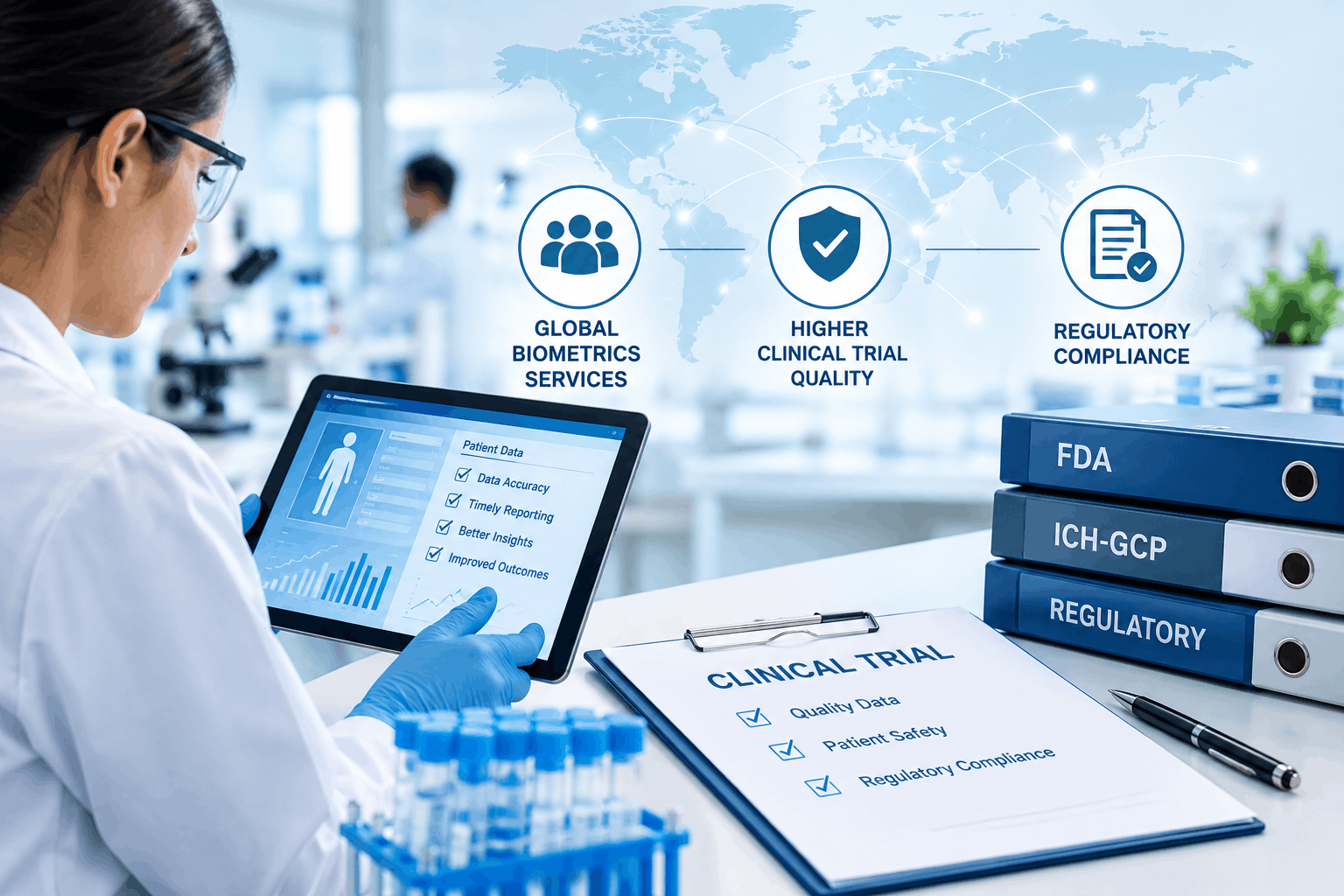
Global Biometrics Services exist to close that gap. At Weltrix, this is where the real work happens: turning raw trial data into something regulators can actually trust, and sponsors can actually use.
What Global Biometrics Services Actually Cover
The term sounds broad because the work is broad. It spans everything from the first case report form to the final submission package.
A complete biometrics function typically includes:
- Biometrics CRO Services
- Clinical Programming
- Data Management CRO
- Biostatistics
- Regulatory Consulting CRO
None of these sit in their own lane for long. A programming slip early on tends to resurface as a statistical headache later, and by the time it reaches regulatory review, it’s a delay measured in months. Five vendors handling five pieces separately is usually how that happens. One team owning the whole chain is usually how it doesn’t.
Where Trial Quality Actually Breaks Down and How Biometrics Fixes It
Quality problems rarely show up with a warning label. More often it’s a query that sat too long, or a dataset that just won’t reconcile no matter how many times someone runs it.
Data accuracy comes first.
Biometrics teams spend the stretch before database lock chasing down exactly this kind of thing, validating entries, resolving inconsistencies, catching what an auditor would otherwise flag months later. An error caught at data entry costs an afternoon. The same error surfacing during submission review can cost a quarter.
Speed matters more than people give it credit for.
A lot of the repetitive review work now runs on automation, which leaves clinical teams free to spend their time on the calls that actually need a human. That’s not about moving faster for its own sake, it’s about decision-makers working off data that’s current, not three weeks old.
Patient safety runs through the same pipeline.
Real-time statistical monitoring means a safety signal gets flagged while there’s still time to act on it, not after the next scheduled review meeting.
Operational risk drops when workflows are standardized.
Fewer protocol deviations. Fewer missing fields. Fewer studies stuck waiting on a report that should have taken a day.
Clinical Programming: The Layer Regulators Actually Read
Raw trial data means nothing to a reviewer until it’s structured correctly. That’s the job clinical programming does, and it’s easy to underestimate until a submission comes back with formatting queries instead of scientific ones.
The core deliverables here include:
- SDTM dataset creation
- ADaM dataset development
- Statistical Analysis Dataset preparation
- Tables, Listings, and Figures (TLFs)
- SAS programming
- Data validation and quality checks
Weltrix’s programming team builds these datasets with submission readiness in mind from the first line of code, not as a cleanup exercise at the end. That distinction shows up later, when a review cycle takes weeks instead of months.
Why Data Management CRO Work Sets the Ceiling for Everything Else
A trial’s data management function decides how far the rest of the study can go. Get it wrong early, and every downstream team inherits the problem.
The core responsibilities span:
- Clinical database design
- Electronic Case Report Form (eCRF) development
- Data validation
- Query management
- Data cleaning
- Database lock activities
Clean data management doesn’t just prevent errors. It shortens the distance between investigators, sponsors, and regulatory authorities, three groups that need to trust the same numbers for a trial to move forward at all.
Where Regulatory Consulting CRO Support Earns Its Keep
Regulatory expectations shift by country, sometimes by agency within the same country. Sponsors running global trials feel this constantly, a dataset format accepted in one jurisdiction gets flagged in another.
Regulatory Consulting CRO services help organizations:
- Prepare submission-ready datasets
- Stay aligned with international guidelines as they shift
- Get ready for regulatory inspections before they’re scheduled
- Maintain documentation standards
- Cut down on avoidable submission risk
Bring in regulatory expertise early enough, and the last-minute scramble that turns a routine submission into an emergency mostly just doesn’t happen.
CDISC Standards: The Common Language Regulators Expect
Every reviewer, at every agency, wants roughly the same thing: data laid out in a format they don’t have to stop and decode.
That’s what CDISC (Clinical Data Interchange Standards Consortium) standards give them. The most common ones include:
- SDTM (Study Data Tabulation Model)
- ADaM (Analysis Data Model)
- Define.xml
Compliance with CDISC Standards isn’t a bureaucratic checkbox. It’s what lets a reviewer move through a submission without stopping to decode unfamiliar formatting, and that translates directly into shorter review cycles.
What Sponsors Gain From Working With Biometrics CRO Services
Bringing biometrics work under one experienced team, rather than splitting it across multiple vendors, changes the shape of a trial’s timeline.
The benefits tend to cluster around:
- Improved data quality
- Faster study timelines
- Better regulatory compliance
- Reduced operational costs
- Efficient data analysis
- Enhanced decision-making
- Greater patient safety
- Scalable global support
Fewer handoffs. Fewer version-control headaches. One team accountable for the full data lifecycle instead of five teams pointing at each other when something slips.
Why Sponsors Choose Weltrix
Every trial carries its own pressure points: a tight enrollment window, a first-in-human safety concern, a submission deadline that won’t move. Weltrix builds its Global Biometrics Services around whatever pressure point a given study is facing, rather than applying the same playbook to every sponsor.
That work spans:
- Comprehensive Biometrics CRO Services
- Clinical Programming
- Data Management CRO
- Regulatory Consulting CRO
- Statistical analysis support
- CDISC Standards implementation
- Global Clinical Research Services
A single-site Phase I study and a multi-country pivotal trial don’t look alike on paper, but the underlying job is the same either way: get the data right, program it cleanly, and map it to standards regulators already know how to read.
The Bottom Line
Trials keep spreading across more countries, generating more data, drawing more scrutiny than they did five years back, and none of that trend is reversing anytime soon. Global Biometrics Services are what keep that complexity from turning into delay.
Weltrix brings Biometrics CRO Services, Clinical Programming, Data Management CRO, Regulatory Consulting CRO, and CDISC Standards expertise together under one roof, built for sponsors who need their data ready the first time a reviewer opens it.
Talk to Weltrix about your trial’s biometrics needs, and find out what a submission looks like when the data was right from the start.
Frequently Asked Questions
Q. What are global biometrics services in clinical trials?
Global biometrics services cover the data functions that turn trial conduct into a submission: clinical data management, statistical programming, biostatistics, and the regulatory support that gets those outputs into a format an agency will accept. The word global matters because a study running across multiple countries has to satisfy more than one authority from a single set of datasets.
Q. What is the difference between data management and biostatistics?
Data management is responsible for the data being right. Biostatistics is responsible for what the data means. Data managers design the database, build edit checks, raise and resolve queries, and take the study to database lock. Biostatisticians write the statistical analysis plan, define the estimands and analysis populations, and interpret the results. Statistical programming sits between them, building the SDTM and ADaM datasets and the tables, listings, and figures that carry the analysis.
Q. Which CDISC standards does the FDA actually require?
SDTM, ADaM, SEND, and Define-XML are required for the study types and dates listed in the FDA Data Standards Catalog. CDASH is widely used for case report form design and is not mandated. The obligation is triggered by study start date rather than submission date: studies beginning on or after 17 December 2016 for NDAs, ANDAs and BLAs, and 17 December 2017 for commercial INDs.
Q. Can a submission be rejected for data formatting alone?
Yes. FDA runs automated technical rejection checks at the gateway, covering the Study Tagging File, a Trial Summary dataset containing study start date, correct file tags, and required datasets with their Define-XML. A package failing any of these is rejected before scientific review begins. The checks run in sequence, so the first failure hides whatever else is wrong behind it.
Q. When should a sponsor bring in a biometrics CRO?
Before the database is built, not after the last patient visit. Edit checks written into the eCRF at design stage prevent discrepancies that would otherwise become queries months later, and CDISC mapping decisions made during database design cost far less than retrofitting SDTM onto a database that was never structured for it. Sponsors who engage at data cleaning or later inherit choices they cannot easily undo.
Q. What is database lock, and why does the date carry so much weight?
Database lock is the point at which the trial database is closed to further changes, after all queries are resolved and the data has been reviewed and reconciled. It matters because unblinding and primary analysis follow it. Reopening a locked database is possible and it is documented, scrutinised, and something every team would rather avoid.
Q. Does outsourcing biometrics transfer regulatory responsibility to the CRO?
No. ICH E6(R3) allows a sponsor to transfer trial-related duties to a service provider while holding the sponsor responsible for the quality and integrity of the resulting data. A contract moves the work. It does not move the accountability, which is why sponsors need enough internal capability to review what a partner delivers.
Q. How many vendors should handle biometrics on one study?
There is no fixed answer, but every handoff between organisations is a place where a specification gets interpreted twice. Splitting data management, programming, and biostatistics across separate vendors is workable when the interfaces are defined in writing and someone owns the whole chain. It goes wrong when nobody does, and the symptom is usually a reconciliation problem that surfaces close to lock.
Leave A Comment