
 By Weltrix
A Phase III dataset with a clean audit trail and a shaky one can look identical on the surface. The difference only shows up when an FDA reviewer or an EMA inspector starts asking questions nobody on the sponsor side can answer cleanly.
That gap is where most trial delays actually live. Not in recruitment. Not in site activation. In the months after database lock, when a regulatory submission stalls because a query wasn’t closed, a derivation wasn’t documented, or a dataset didn’t map to CDISC SDTM the way a reviewer expected.
Sponsors running global studies are dealing with more sites, more data sources, and more scrutiny than they were five years ago. ICH’s E6(R3) Good Clinical Practice guideline, finalized in January 2025 and adopted by FDA in September 2025, pushes harder on risk-based quality management and sponsor accountability than its predecessor did. The regulatory bar moved. Internal teams stretched thin across multiple trials often can’t move with it.
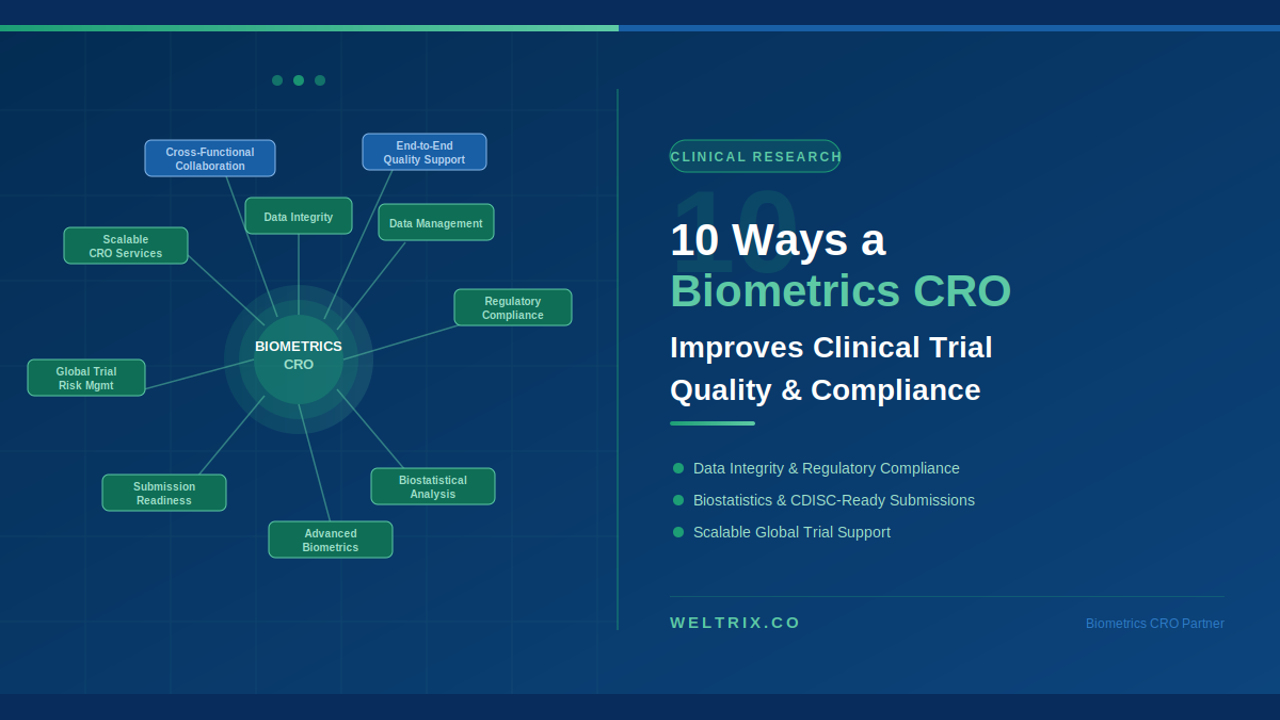
A specialized biometrics CRO exists to close that gap — biostatistics, statistical programming, clinical data management, and regulatory affairs working as one coordinated function instead of four disconnected ones. This piece walks through ten specific ways that partnership improves clinical trial quality and compliance, what each one actually looks like in practice, and where the line sits between handling it in-house and bringing in outside expertise.
Why Biometrics Is Critical to Clinical Trial Success
Understanding Clinical Research Biometrics
Clinical biometrics covers the quantitative backbone of a trial: statistical design, data management, statistical programming, and the analysis that turns raw case report forms into evidence a regulator can act on. It’s not an adjacent function. It’s the layer that determines whether everything else — every enrolled patient, every site visit, every protocol amendment — produces a result anyone can trust.
The scope runs wide. Designing the statistical analysis plan. Building the database. Cleaning the data as it comes in, not after the fact. Producing SDTM and ADaM datasets that match what a reviewer expects to see. None of these are isolated tasks; they’re sequential dependencies, and a weak link anywhere in that chain shows up downstream. Understanding how end-to-end biometrics services improve clinical trial success starts with recognizing how tightly those dependencies connect.
The Link Between Data Quality and Regulatory Success
Poor data quality doesn’t fail quietly. It fails in front of a review division, usually after the sponsor has already spent years and tens of millions of dollars getting there.
FDA’s own framework for what counts as acceptable trial data is unambiguous on this point: data should be attributable, original, accurate, contemporaneous, and legible — the ALCOA principle that underlies every data integrity expectation the agency applies during inspection. Documentation gaps, inconsistent derivations, or datasets that don’t reconcile against source data don’t just slow a submission down. They invite the kind of agency scrutiny that can sink one entirely. It’s one of the core reasons why choosing the right clinical biometrics CRO matters for trial success — the partner responsible for your data quality is also, in effect, responsible for your regulatory outcome.
Way #1: Strengthening Clinical Trial Data Integrity
Establishing Robust Data Validation Processes
Good data cleaning happens continuously, not in a frantic push before database lock. A biometrics CRO builds automated validation checks directly into the data capture system — range checks, cross-form logic checks, protocol-deviation flags — so anomalies surface within days of entry, while a site coordinator still remembers the visit clearly enough to resolve it.
Reducing Data Errors and Inconsistencies
Real-time monitoring dashboards let a data manager spot a site that’s consistently entering vitals incorrectly before it becomes a pattern across forty patients. Paired with disciplined query management — clear escalation timelines, no queries sitting open for months — this is how data integrity holds up across a trial that might run for years. The data management services underpinning this kind of continuous oversight are what separate proactive quality control from reactive damage limitation.
Way #2: Enhancing Clinical Trial Quality Through Expert Data Management
Streamlined Clinical Data Management
Standardized data collection instruments and a well-designed database schema prevent the kind of structural mess that turns programming into archaeology later. A biometrics CRO designs the database around the statistical analysis plan from day one, not after the first interim analysis reveals the schema doesn’t support it.
Improving Data Accuracy Across Study Sites
Twelve sites following twelve slightly different interpretations of a data entry convention is a common failure mode in studies without centralized oversight. Consistent handling procedures, paired with a single point of accountability for data quality across the entire study, keep accuracy uniform regardless of geography. This is precisely the discipline that CRO data management services are built to enforce at scale.
Way #3: Supporting Regulatory Compliance Requirements
Meeting FDA, EMA, and ICH Standards
The compliance bar isn’t static. ICH released the revised Good Clinical Practice guideline E6(R3) in January 2025, with FDA adoption following in September 2025, and the EMA set July 2025 as the effective date for the principles and Annex 1 portions in the EU. Health Canada has set its own implementation date of April 2026. A sponsor running a multi-region trial right now is navigating three different timelines for the same underlying standard, and a biometrics CRO that tracks regulatory change for a living is the difference between reacting to that shift and getting blindsided by it.
Preparing for Audits and Inspections
An audit trail that can’t reconstruct who changed what, when, and why is a finding waiting to happen. Documentation readiness isn’t a binder assembled before an inspection — it’s a discipline baked into how data is captured and changes are logged from the first patient enrolled. The CRO services built around this standard of readiness treat compliance as infrastructure, not afterthought.
Way #4: Delivering Accurate Biostatistical Analysis
Designing Reliable Statistical Plans
A statistical analysis plan written loosely invites disputes later — about which population to analyze, which endpoint takes precedence, how missing data gets handled. A biometrics CRO writes the SAP with enough specificity that there’s no ambiguity left for a reviewer, or a sponsor’s own team, to argue about months after the data is locked. Biostatistics services anchored in that level of precision are what allow a trial’s statistical output to hold up under the scrutiny it will inevitably face.
Generating Trustworthy Clinical Evidence
Statistical output only matters if the interpretation behind it is sound. Biostatisticians who understand both the methodology and the clinical context are what separate a p-value from an actual basis for a go/no-go decision.
Way #5: Improving Quality Through Advanced Biometrics Solutions
Leveraging Automation and Analytics
Risk-based monitoring concentrates site visits and data review where the risk actually concentrates, instead of spreading equal attention evenly across every site regardless of performance. Predictive analytics applied to enrollment and data quality trends can flag a struggling site months before it becomes an expensive problem. Understanding the full range of biometrics solutions for clinical trials makes clear how much of this analytical capability is now table stakes, not a premium add-on.
Using Technology to Identify Risks Earlier
Trend detection across sites — unusual adverse event clustering, abnormal protocol deviation rates — catches quality issues while they’re still small enough to fix without derailing the timeline.
Way #6: Accelerating Regulatory Submission Readiness
Standardized Reporting Processes
Clinical study reports and submission-ready datasets built to specification the first time avoid the reviewer back-and-forth that adds months to an approval timeline. This is largely a function of how disciplined the underlying data management was twelve months earlier.
Supporting CDISC Compliance
SDTM standardizes how raw clinical data is structured for submission; ADaM standardizes the analysis datasets derived from it. Both are functionally mandatory for FDA submissions, and getting them wrong late in a program means reprogramming under deadline pressure — exactly the conditions where new errors get introduced. The statistical programming and analysis work that produces submission-ready SDTM and ADaM datasets is where the accumulated discipline of the entire data management effort either pays off or doesn’t.
Way #7: Reducing Operational Risks Across Global Clinical Trials
Managing Multi-Region Data Complexity
A trial running across the US, EU, and Asia-Pacific is reconciling different regulatory expectations, different site infrastructure, and often different data formats. Harmonizing all of it into one coherent dataset is a specialized skill, not a byproduct of good intentions. It’s one of the primary reasons sponsors outsource biometrics to a CRO rather than attempt to build that global coordination capability in-house.
Improving Oversight and Governance
Centralized quality control means one team sees the whole trial, rather than each region’s data manager seeing only their own slice. That visibility is what catches a systemic issue before it propagates across every site.
Way #8: Providing Scalable Biometrics CRO Services
Supporting Growing Trial Demands
A sponsor with one Phase II trial doesn’t need the same biometrics infrastructure as one running four overlapping Phase III programs. Outsourced biometrics scales up or down with the actual portfolio, instead of leaving a sponsor either understaffed during a crunch or carrying idle headcount between trials. The full scope of CRO services available through a dedicated biometrics partner covers exactly that range — from a single-study engagement to multi-program support across a sponsor’s entire pipeline.
Managing Complex Study Portfolios
Oncology trials with adaptive designs, rare disease studies with small and heterogeneous populations — these need statisticians who’ve actually built analysis plans for that specific complexity before, not generalists learning on the sponsor’s timeline.
Way #9: Enhancing Collaboration Between Sponsors and Study Teams
Improving Cross-Functional Communication
Clinical operations and data management often operate in separate workflows that only intersect at monitoring visits. A biometrics CRO that integrates with both keeps protocol deviations, data queries, and operational decisions moving through one coordinated channel instead of three disconnected ones. The importance of clinical programming in CROs is part of this same coordination story — when programming sits inside the same team as data management and biostatistics, the feedback loops that keep a trial on track actually close.
Creating More Efficient Workflows
Faster query resolution and clearer project visibility for the sponsor’s internal team turn what’s often an opaque vendor relationship into something closer to an extension of the in-house team.
Way #10: Delivering End-to-End Quality and Compliance Support
Integrated Biometrics CRO Services
Biostatistics, statistical programming, and clinical data management under one accountable team — rather than three separate vendors who each optimize for their own deliverable — removes the handoff points where quality typically erodes. End-to-end biometrics services structured this way don’t just reduce friction; they change the accountability model entirely.
Driving Long-Term Trial Success
Consistent quality standards applied trial after trial, across a sponsor’s full pipeline, compound. The second study benefits from lessons the first one surfaced. The fifth study runs on a level of process maturity the first one never had.
Biometrics CRO vs In-House Biometrics Teams
Benefits of Internal Biometrics Teams
Direct control over priorities and deep organizational knowledge of a sponsor’s specific therapeutic area are real advantages an in-house team has that no outside partner fully replicates.
Advantages of Outsourcing to a Biometrics CRO
Specialized expertise across a wider range of trial designs, the ability to scale resources to match a specific study’s demands, and a cost structure that doesn’t carry the overhead of permanent headcount between trials. The case for outsourcing biometrics comes down to access: access to depth of expertise, to infrastructure that’s already built, and to a team whose regulatory knowledge updates continuously because that’s the only thing they do.
Choosing the Right Model for Your Organization
The decision usually comes down to trial volume, therapeutic complexity, and how predictable the pipeline is. Many sponsors land on a hybrid model — a lean internal team setting strategy, a biometrics CRO executing the specialized statistical and data management work at scale. Weltrix’s CRO services are built precisely for that kind of partnership, integrating at whatever depth the sponsor’s internal structure requires.
Common Mistakes That Impact Clinical Trial Quality and Compliance
Inadequate Data Validation Processes
Treating data cleaning as a pre-lock activity instead of a continuous one is the single most common source of late-stage data quality surprises.
Delayed Compliance Planning
Waiting until submission preparation to think seriously about CDISC compliance or audit-trail completeness means retrofitting standards onto data that wasn’t built with them in mind.
Choosing Vendors Based Solely on Cost
The cheapest biometrics quote rarely accounts for the cost of rework when a dataset fails an internal QC review six months later. Therapeutic area experience and a demonstrable compliance track record matter more than the line-item price. Understanding what separates a capable clinical biometrics CRO from a commodity vendor is the starting point for making that evaluation correctly.
Expert Insights and Future Trends in Clinical Biometrics
Emerging Technologies Improving Trial Quality
AI-powered analytics are increasingly applied to anomaly detection in clinical data, and automated quality checks are replacing what used to be manual line-by-line review. FDA has signaled openness to these tools while maintaining that the underlying data integrity expectations don’t change just because the method of checking them does. Clinical programming capabilities are evolving in parallel, with automation taking over the more mechanical aspects of validation and freeing programming teams for the higher-order work that actually requires judgment.
The Future of Biometrics CRO Services
Expect more automation in data review, sharper regulatory focus on decentralized and hybrid trial designs following ICH E6(R3)’s formal recognition of those models, and continued expansion of data-driven biometrics services as sponsors run more complex, more global trial portfolios than they did even three years ago. The full picture of where biometrics services are heading — and what sponsors need to demand from their CRO partners — is already being shaped by those shifts.
FAQ
Q. How does a biometrics CRO improve clinical trial quality?
A biometrics CRO improves clinical trial quality by combining specialized biostatistics, statistical programming, and clinical data management under one accountable team, catching data errors early through automated validation, designing statistically sound analysis plans, and producing CDISC-compliant datasets that hold up to regulatory review.
Q. What biometrics CRO services are most important for regulatory compliance?
The services most critical for compliance are clinical data management with built-in audit trails, SDTM and ADaM dataset programming, statistical analysis planning aligned to ICH E6(R3) and FDA expectations, and ongoing documentation practices that support inspection readiness throughout the trial, not just at submission.
Q. How do biometrics solutions help maintain data integrity?
Biometrics solutions maintain data integrity through automated validation checks at the point of data entry, real-time monitoring that flags anomalies before they compound, and centralized oversight that applies the same quality standard across every site in a trial regardless of geography.
Q. Why is data integrity critical in clinical trials?
Data integrity is critical because regulators evaluate clinical evidence on whether it’s attributable, original, accurate, contemporaneous, and legible, the ALCOA standard FDA applies during inspection. A trial that can’t demonstrate that standard risks delayed approval, additional regulatory scrutiny, or rejection of the submission altogether.
Q. When should sponsors outsource biometrics services?
Sponsors should consider outsourcing biometrics services when internal teams lack capacity for the trial’s complexity, when a study requires specialized statistical expertise the in-house team hasn’t built (adaptive designs, rare disease populations), or when running multiple concurrent trials makes a flexible, scalable resource more efficient than expanding permanent headcount.
Conclusion
Ten ways, one underlying pattern: clinical trial quality and compliance hold up when biostatistics, data management, and regulatory readiness are treated as one coordinated discipline instead of three separate problems handled by three separate teams under three separate deadlines.
Strong data integrity isn’t a checkbox completed before submission. Regulatory readiness isn’t a sprint that starts when ICH or FDA finalizes new guidance. Both are built into how a trial is run from the first patient enrolled, and that’s exactly where a specialized biometrics CRO partner earns its place in the program, rather than getting brought in only after something has already gone wrong.
Sponsors weighing whether their current data integrity and compliance infrastructure can handle what’s coming next, a more complex trial, a new region, a tighter timeline,all are usually better served exploring dedicated biometrics CRO services before that gap shows up in front of a reviewer.
Key Takeaways
- Clinical trial data integrity depends on continuous validation, not a pre-lock cleanup sprint.
- ICH E6(R3), finalized in January 2025 and adopted by FDA in September 2025, raises the bar on risk-based quality management and sponsor accountability.
- CDISC SDTM and ADaM compliance built in from database design avoids costly reprogramming before submission.
- Risk-based monitoring and predictive analytics catch site-level quality issues before they scale across a trial.
- Outsourcing biometrics services offers scalability that fixed in-house headcount struggles to match across a variable trial portfolio.
- The cheapest biometrics vendor is rarely the most cost-effective once rework and compliance risk are factored in.
- A hybrid model, internal strategy, outsourced specialized execution, works well for sponsors balancing control with scalability.
Leave A Comment