
 By Weltrix
The numbers are sobering. Approximately 90% of drug candidates entering clinical trials never reach approval, and the average cost of bringing a single drug to market has climbed to around $2.6 billion when accounting for failures. For sponsors, every strategic decision carries real weight — including one that often doesn’t get the scrutiny it deserves: who manages your clinical trial biometrics.
Biometrics in clinical research isn’t a support function. It’s a structural one. The quality of your data, the soundness of your statistical plan, and the precision of your submission deliverables all run directly through your biometrics team. Get it right, and your compound gets a fair shot. Get it wrong, and even solid science can fail at the regulatory gate.
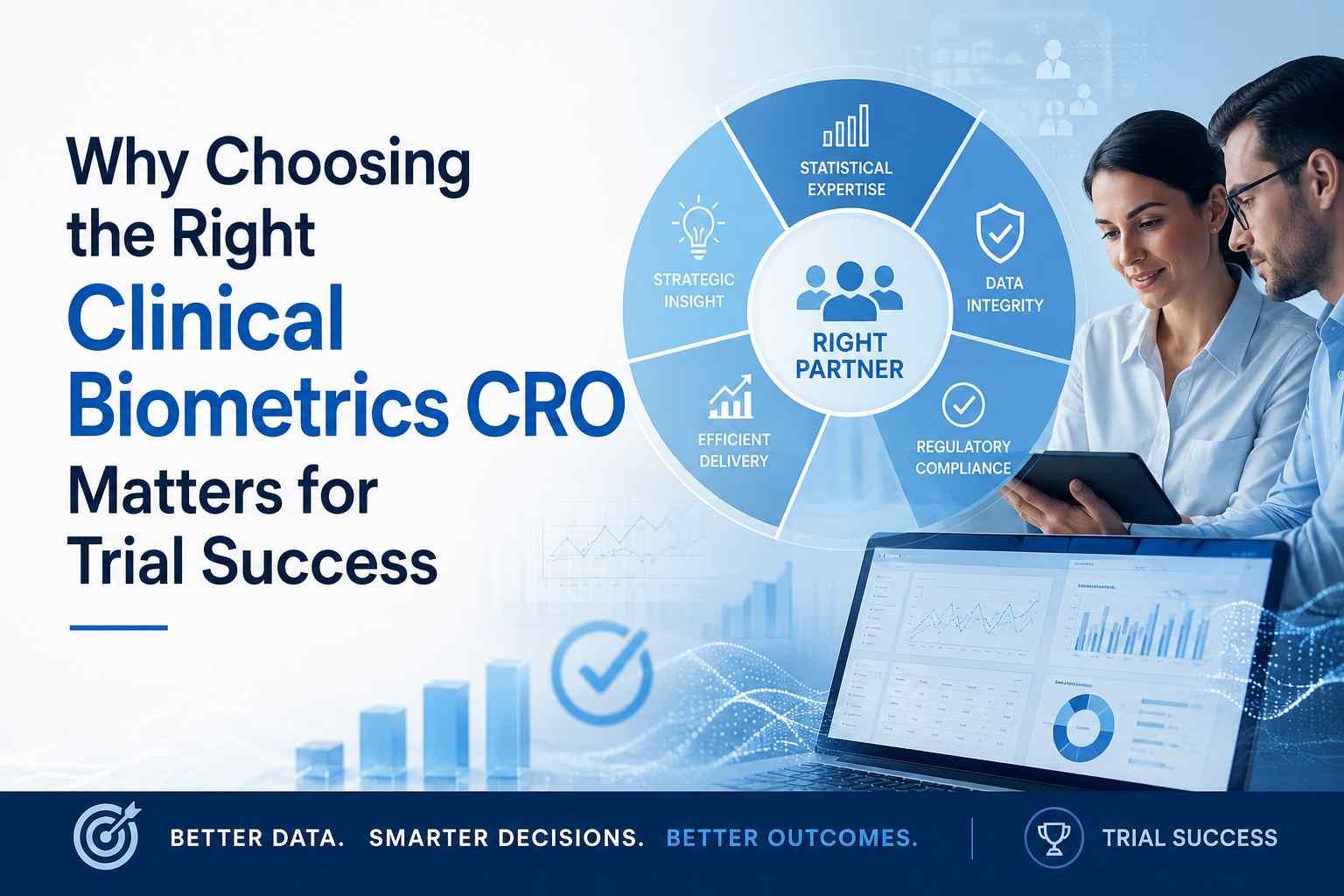
Choosing the right clinical biometrics CRO is one of the highest-leverage decisions a sponsor makes in the entire development lifecycle. It deserves to be treated that way.
What Clinical Trial Biometrics Actually Covers
The term “biometrics” means different things in different industries. In clinical research, it refers to the specialized disciplines that manage, analyze, and report the data flowing out of a clinical trial.
At its core, clinical trial biometrics draws on three interlocking functions: clinical data management, biostatistics, and statistical programming. Done in isolation, each is vulnerable. Done together by an experienced team, they create the infrastructure that holds a study together under regulatory scrutiny. Many sponsors rely on specialized Biostatistics Services for Clinical Research to ensure study designs, statistical methodologies, and regulatory requirements are aligned from the earliest stages of development.
In practice, biometrics services span:
- Statistical Analysis Plan (SAP) development and study sample size calculations
- Electronic Data Capture (EDC) build, validation, and database management
- CDISC SDTM and ADaM dataset development
- SAS and R programming for Tables, Listings, and Figures (TLFs)
- Medical coding using MedDRA and WHO Drug dictionaries
- Clinical Study Reports, ISS, and ISE support for regulatory submissions
Each element connects to the next. A poorly structured SAP creates downstream problems in ADaM. A non-compliant SDTM dataset triggers reviewer questions before anyone reads a single efficacy result. And when regulatory affairs support isn’t built into the same workflow — the submission package suffers for it.
The Regulatory Stakes Are Higher Than Most Sponsors Realize
The FDA doesn’t review your compound in isolation — it reviews your submission package. And that package lives and dies on the quality of what your biometrics team produced.
The FDA’s study data standards require that all NDAs, BLAs, and ANDAs include data in CDISC-compliant formats — specifically SDTM for tabulation data and ADaM for analysis datasets. This has been mandatory since December 2016 for studies submitted to CDER. Yet sponsors who don’t build their data infrastructure to this standard from the start of a study routinely find themselves scrambling to reverse-engineer datasets at the end — an expensive, error-prone process that delays submissions and invites scrutiny.
Strong data management from day one isn’t just good practice. It’s what separates a clean database lock from a three-round cleaning crisis.
The updated ICH E6(R3) Good Clinical Practice guideline, which came into effect in July 2025, adds further expectations around data governance, electronic audit trails, and risk-based quality management. These aren’t theoretical requirements. FDA inspectors examine them directly. A biometrics CRO that builds clean, traceable, GCP-aligned data systems from day one eliminates the vast majority of these vulnerabilities before they surface.
Regulatory confidence is built on data quality. There’s no shortcut around that.
Why the CRO Selection Decision Is Underestimated
Sponsors frequently spend weeks comparing clinical operations vendors and hours comparing biometrics partners. That imbalance is a mistake — and it’s a common one.
Here’s why it happens: biometrics work is largely invisible during trial conduct. Sites are enrolling patients, monitors are in the field, and the data team is working quietly in the background. It only becomes visible at database lock, when all of that accumulated work — or accumulated error — becomes apparent at once.
By that point, fixing problems is expensive. Re-running analyses because the Statistical Analysis Plan was underspecified adds weeks. Rebuilding SDTM domains that don’t pass Pinnacle 21 conformance checks delays lock. Discovering that statistical programming used proprietary macros that the sponsor can’t access after the study ends creates submission complications that surface at exactly the wrong time.
These aren’t hypothetical scenarios. They’re common ones, and they trace back to biometrics partner selection made too quickly, too late, or against the wrong criteria.
Six Questions That Should Drive Your CRO Evaluation
When you’re assessing clinical biometrics CRO partners, these are the questions worth spending serious time on.
1. Who is actually running your study after kickoff?
This is the single most important question. It’s common for senior scientists to present during the sales process and for junior staff to be assigned once a contract is signed. Ask directly who owns day-to-day delivery, get names, and request direct contact information for those people before the contract is finalized.
2. When do they engage on statistical planning?
The SAP should be developed alongside — not after — the protocol. Biostatistics and CDISC domain structure should be mapped before any data collection begins. Sponsors working with experienced providers of clinical biostatistics CRO services gain the advantage of proactive statistical planning, reducing the risk of costly protocol amendments, data inconsistencies, and submission delays. A CRO that sequences statistical planning as a late-stage activity is setting the sponsor up for rework and delay.
3. How do they handle CDISC compliance throughout the study?
Compliant SDTM and ADaM built from the start is fundamentally different from datasets reverse-engineered at study end. The FDA’s Technical Conformance Guide is explicit about what reviewers look for. Ask specifically when Pinnacle 21 conformance checks occur and how discrepancies are documented and resolved.
4. What quality control processes apply to TLFs?
Independent dual programming on critical outputs is the standard in a serious biometrics operation. Ask specifically what QC methodology applies to every Table, Listing, and Figure — not just to primary endpoints.
5. How transparent is their project management?
Vague progress updates and change-order-heavy contracts are red flags. Rolling deliverables with real-time milestone visibility give sponsors the ability to course-correct before problems compound. A biometrics partner with nothing to hide operates transparently.
6. What is their specific regulatory submission track record?
Not generically — specifically. IND, NDA, BLA, ANDA experience. Pre-IND meeting preparation. Familiarity with the ICH E9(R1) estimand framework, which FDA reviewers apply routinely now. Regulatory affairs expertise isn’t a separate workstream — it should be embedded in how your biometrics partner operates from day one.
The True Cost of Getting This Wrong
Most sponsors model the cost of CRO services in their budget. Fewer model the cost of choosing the wrong one.
Database lock delays ripple forward into everything — site payments, regulatory timelines, partner milestone triggers, board reporting, and investor conversations. The NIH research on clinical trial failure consistently identifies data-related failures as a significant contributor to development setbacks — problems that better upstream data infrastructure would have prevented.
There’s also the submission timeline to consider. Clean, standardized, well-documented data dramatically accelerates Integrated Summary of Safety and Efficacy development when it’s time to file. Sponsors who’ve worked with fragmented or non-compliant datasets know exactly how painful this gets at the back end of a development program.
Clean data at database lock isn’t optional. It’s the entire point of the exercise.
How Weltrix Delivers End-to-End Clinical Biometrics CRO Services
Not every CRO is built the same way. Weltrix is a specialized clinical biometrics CRO purpose-built for emerging and mid-size biotech sponsors — the companies that can’t afford to lose time, budget, or data integrity to a partner that isn’t fully invested in their study.
Here’s what that looks like in practice across their core service areas:
- Biostatistics – Through comprehensive Biostatistics Services for Clinical Research, Weltrix supports protocol-embedded Statistical Analysis Plans, sample size calculations, DSMB reports, and interim analysis design. The team works within the ICH E9(R1) estimand framework — the standard FDA reviewers now apply routinely.
- Statistical Programming – SAS and R-based programming of Tables, Listings, and Figures (TLFs), paired with dual-programming methodology and Independent Quality Control (IQC) on every critical output.
- Data Management EDC build and validation across platforms including Medidata Rave, REDCap, and Oracle InForm. CRF design, Data Validation Specifications, SAE reconciliation, and medical coding (MedDRA / WHO Drug) — all structured so that database lock is a milestone, not a crisis.
- Regulatory Affairs Weltrix provides comprehensive regulatory affairs services, including eCTD submission planning, IND/NDA/BLA module authoring, FDA meeting preparation, DCGI dossier support, and ICH-GCP audit readiness.
- Medical Writing Clinical Study Reports (CSRs per ICH E3), Investigator’s Brochures, protocols, informed consent forms, and product labels written to meet global regulatory expectations.
With extensive experience delivering clinical biostatistics CRO services, Weltrix helps sponsors maintain data quality, regulatory compliance, and submission readiness throughout the clinical development lifecycle.
What the Right Biometrics CRO Partnership Looks Like
The right clinical biometrics CRO operates as an extension of your internal team — not a vendor fulfilling a statement of work from a distance.
That means senior scientists on every study, not junior staff handed assignments post-kickoff. It means biostatistics and data management aligned from the protocol stage — not introduced after trial conduct is underway. It means transparent communication with the statistician and programmer doing the actual work, not relayed messages through layers of account management.
It also means technical flexibility. Both SAS and R are in active use across regulatory submissions. The FDA has been evaluating Dataset JSON as a potential future replacement for the legacy XPT format, and the technical landscape continues to evolve. A biometrics partner that operates with modern tooling and current regulatory awareness is worth far more than one simply doing things the way they’ve always been done.
The partnership also needs to account for the full lifecycle. Sponsors managing multiple studies benefit from a biometrics partner who carries consistent data standards and institutional knowledge forward into later phases and eventual submission.
Getting This Right From the Start
Clinical research is hard. The science is uncertain, timelines shift, and regulatory requirements evolve. What shouldn’t be uncertain is whether the data underlying your submission is clean, compliant, and defensible.
Selecting a clinical biometrics CRO isn’t a procurement task to complete quickly so you can move on to other things. It’s a foundational decision that shapes the quality of everything that follows — from the first data point captured in your EDC to the final regulatory submission package reviewed by the FDA.
Invest the time to evaluate deeply. Ask the hard questions. Find a partner whose operational rigor and service depth match what your trial actually demands. Because when every data point represents a patient in a study, accuracy is the only standard that matters.
Leave A Comment