 By Weltrix
The pressure on clinical development teams has never been more specific: faster timelines, more complex data, evolving regulatory requirements — and a talent market where more than a third of drug developers report skill shortages are actively limiting trial progress.
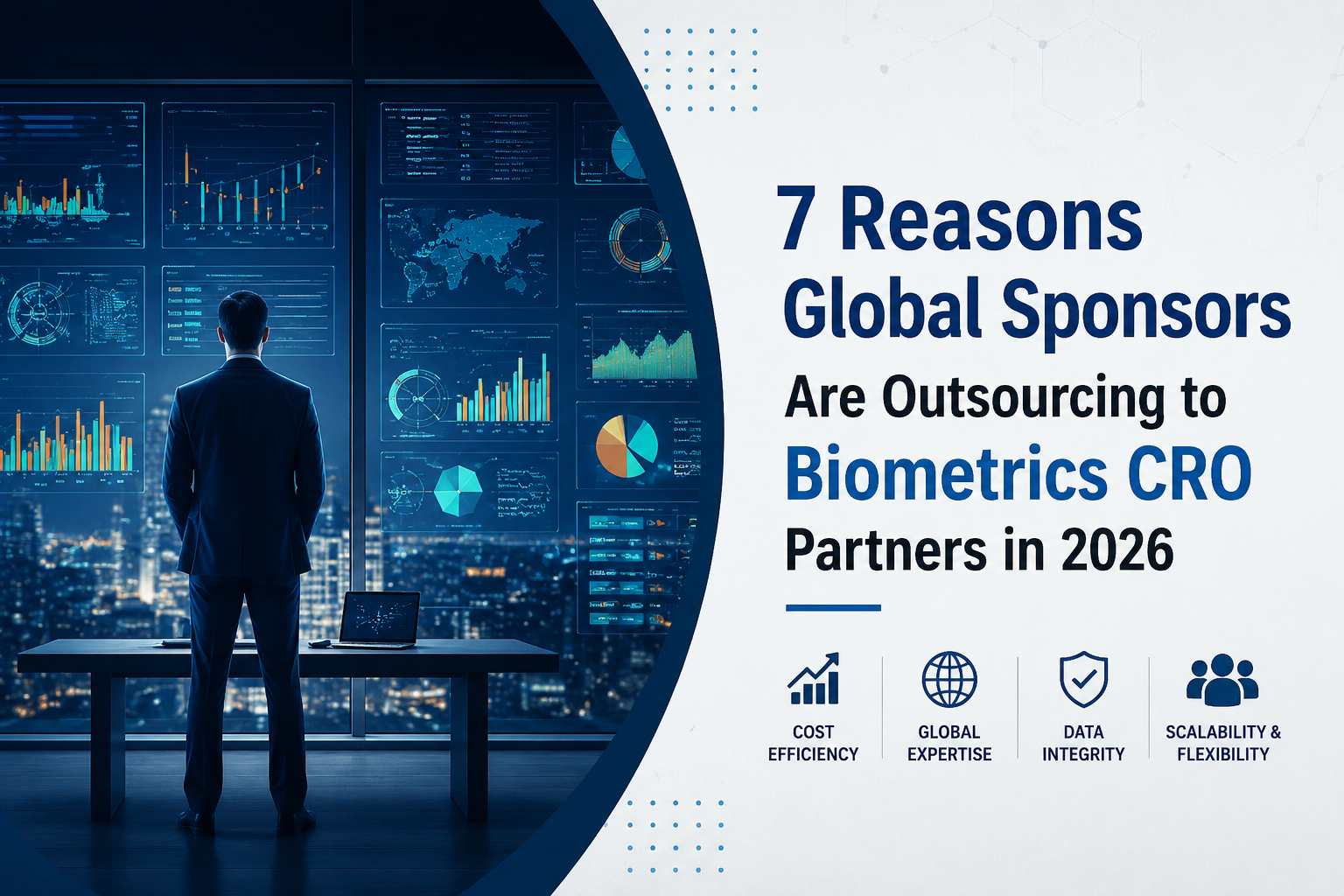
Outsourcing to biometrics CRO partners is no longer a contingency plan for under-resourced teams. In 2026, it’s a deliberate strategic decision made by sponsors who understand exactly what’s at stake when the data side of a trial goes wrong.
Why Clinical Biometrics Has Become Essential
What Is Clinical Research Biometrics?
Clinical biometrics sits at the intersection of data, statistics, and regulatory science. It draws on three functions that must work in concert: biostatistics, statistical programming, and clinical data management. Separate them and you introduce gaps. Integrate them under experienced oversight and you get submission-ready data that holds up under scrutiny.
In practice, biometrics for clinical trials covers:
- Statistical Analysis Plans (SAPs)
- EDC build and validation
- CDISC-compliant SDTM and ADaM datasets
- SAS and R programming for Tables, Listings, and Figures (TLFs)
- Medical coding using MedDRA and WHO Drug dictionaries
- Full regulatory submission deliverables for FDA, EMA, and other authorities
Growing Demand for End-to-End Biometrics Services
Trial data has changed. Decentralized trials, wearable endpoints, EHR integrations, and real-world evidence programs are generating data complexity that most in-house teams weren’t built to manage. Emerging biopharma companies now contribute more than 50% of global clinical pipelines — and most lack the internal infrastructure to handle end-to-end biometrics at scale.
Reason 01 – Access to Specialized Expertise That’s Increasingly Hard to Hire
Filling Critical Talent Gaps in Clinical Biometrics
The talent shortage is documented and worsening. The pharma and life sciences sector runs approximately 35% short of the specialized expertise it needs, with biostatisticians, statistical programmers, and clinical data managers among the hardest roles to fill. Hiring takes months. Onboarding takes more. And when a study ends, you’re either carrying headcount you don’t need or rebuilding capability from scratch.
A specialized biometrics CRO partner gives you direct access to that expertise — without the hiring cycle or the overhead.
Leveraging AI-Supported Biometrics and Advanced Analytics
Nearly half of pharma organizations say skill shortages are blocking their digital and AI initiatives. AI-assisted data validation, adaptive trial modeling, and automated anomaly detection are now embedded in how sophisticated biometrics teams operate. A specialized CRO partner brings both the people and the infrastructure — a combination most mid-size sponsors cannot replicate in-house.
Reason 02 – Faster Global Clinical Trial Execution
Accelerating Timelines Where It Matters Most
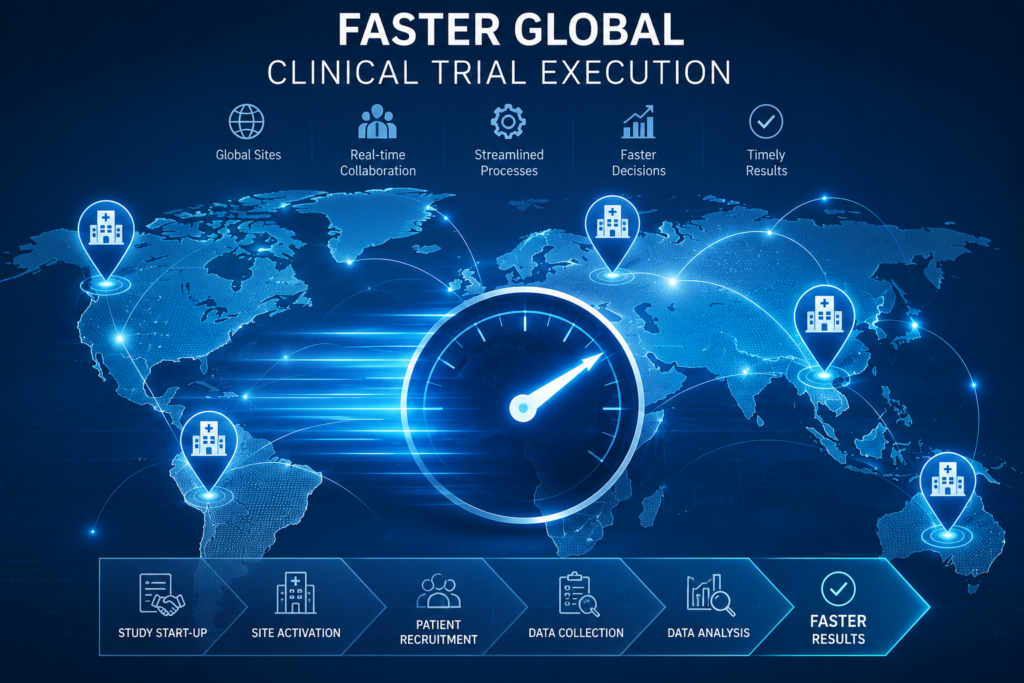
Database lock is the milestone that every downstream activity depends on. Regulatory submission, site payments, investor updates – they all sit behind it. Every week of delay has a calculable cost.
When biometrics services are integrated from protocol design rather than added after enrollment, timelines compress. SAPs finalized before the first patient in. CDISC domains mapped before EDC build. Pinnacle 21 conformance checks running throughout the study – not as a last-minute scramble at lock.
Supporting Multi-Region Global Clinical Trials
FDA, EMA, and CDSCO each carry specific data submission requirements. Aligning datasets across multiple authorities requires deep familiarity with each standard – not surface-level awareness. Experienced biometrics CRO partners run follow-the-sun delivery models with standardized programming libraries and multi-jurisdiction regulatory experience built in. Your study doesn’t stall because a regional requirement wasn’t anticipated in the design phase.
Reason 03 – Better Data Quality and Regulatory Compliance

Meeting FDA, EMA, and ICH Standards From Day One
The FDA mandates CDISC-compliant SDTM and ADaM datasets for all NDA, BLA, and ANDA submissions. This is explicit in the FDA’s Study Data Standards Resources, and the Technical Conformance Guide specifies exactly what reviewers expect. The updated ICH E6(R3) Good Clinical Practice guideline, effective July 2025, adds further requirements around electronic audit trails, data governance, and risk-based quality management.
A biometrics CRO that builds to these standards from study start doesn’t need to retrofit compliance at lock. It arrives there already.
Reducing Submission Risk Through Embedded Quality Control
The ALCOA+ framework – data that is Attributable, Legible, Contemporaneous, Original, and Accurate – is the foundational data integrity standard FDA inspectors apply during audits. Independent dual programming, ongoing Pinnacle 21 validation, and structured audit trails at every stage are what prevent a data quality issue from becoming a regulatory one. A specialized biometrics CRO embeds these at the systems level – not as a final QC pass before submission.
Reason 04 – Cost Efficiency and Flexible Resource Scaling

Lower Operational Costs Without Fixed Headcount
Building an internal biometrics team for a single Phase II study doesn’t make financial sense for most sponsors. Workloads peak around database lock and flatten between studies – but salaries, technology licenses, and training costs don’t flex with your trial schedule. Biometrics outsourcing converts that fixed cost into a variable one scoped to each study’s actual demands.
Scalable Biometrics Support — FSP, Full Outsource, or Hybrid
Large pharma is increasingly shifting toward hybrid FSO/FSP models to optimize cost and risk simultaneously. The right biometrics CRO offers both models – and the judgment to recommend which one fits your program. FSP arrangements let sponsors retain internal oversight while outsourcing specific functions. Full outsourcing hands the entire biometrics workstream to the CRO partner. Both have a place depending on the sponsor’s internal capacity and study complexity.
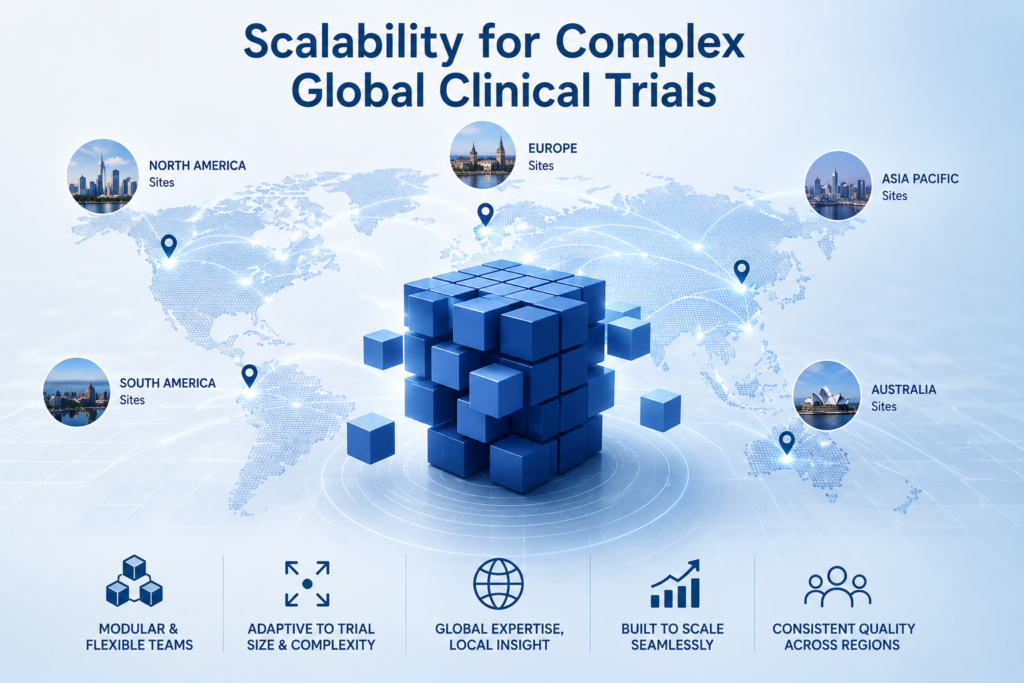
Reason 05 – Scalability for Complex Global Clinical Trials
Managing Oncology, Rare Disease, and Adaptive Trials
Not all trials carry the same biometrics demands. The rare disease market is growing at 11.6% CAGR through 2030, and more than half of all FDA novel drug approvals in 2025 were for rare disease indications. Oncology studies with event-driven endpoints, adaptive designs with pre-specified interim analyses, and small-population trials with complex estimand frameworks require biostatistical expertise that generalist in-house teams often aren’t built to deliver.
Specialized biometrics CRO partners are. And when protocol amendments change workload mid-study, they have the capacity to absorb that change without derailing timelines.
Reason 06 – End-to-End Biometrics Services Improve Operational Efficiency
Integrated Delivery Across the Full Biometrics Spectrum
When biostatistics, statistical programming, and clinical data management operate as one integrated team – aligned to the same standards, communicating in real time – handoff delays disappear. The SAP informs the ADaM structure. The EDC build reflects programming assumptions. TLFs are produced by a team that built the datasets they’re reading.
That’s what end-to-end biometrics services actually deliver. One team, one standard of accountability, one version of the data.
At Weltrix, our biometrics services – spanning biostatistics, statistical programming, data management, regulatory affairs, and medical writing – operate as a unified function. Senior-level oversight across all disciplines. Direct access to the expert doing your work, not a project manager relaying information. Every deliverable built with regulatory submission in mind from the first day of the study.
Reason 07 – Greater Focus on Core Research and Innovation
Allowing Sponsors to Concentrate on Strategic Priorities
Your clinical and regulatory leadership has finite attention. Every hour spent troubleshooting a database issue or reviewing SDTM conformance errors is an hour not spent on protocol strategy, site selection, or pipeline decisions. Biometrics outsourcing returns that attention to where it creates the most value.
Faster database lock also means earlier results – earlier go/no-go decisions, earlier partner conversations, and earlier access to capital. For biotechs on a limited runway, the difference between locking six weeks early and six weeks late has real strategic consequences.
Biometrics CRO vs. In-House Teams
In-house teams carry real advantages – organizational knowledge, direct access to leadership, and institutional familiarity with a compound’s history. For large pharma with stable, high-volume pipelines, building that internal capability makes sense.
For most sponsors, the math works differently. An independent biometrics CRO delivers scalable expertise without fixed headcount costs, regulatory depth across multiple jurisdictions simultaneously, and senior-level execution on every study regardless of size. Capacity constraints in internal teams tend to surface at exactly the wrong moments – when a study needs to accelerate or a second program launches.
The most effective structure for many sponsors is hybrid: internal leadership and scientific oversight, outsourced biometrics execution with full transparency at every stage.
Common Mistakes to Avoid When Outsourcing Biometrics
- Choosing on cost alone. The least expensive proposal is rarely the least expensive outcome. Non-compliant datasets or statistical errors caught during FDA review cost far more to fix than a higher-quality partner would have cost upfront.
- Ignoring regulatory depth. Ask specifically: when do Pinnacle 21 checks occur? Who authors the ADRG? What happens when a dataset fails validation? Surface-level FDA experience and genuine submission expertise are not the same thing.
- Failing to assess scalability. A CRO that works well on a single-region Phase II may not have the infrastructure for a global adaptive Phase III. Assess delivery capacity and multi-jurisdiction experience before the contract is signed.
Key Industry Trends in 2026
Three shifts are reshaping what biometrics CRO partners need to deliver:
- AI-driven analytics have moved from pilot programs to operational standard – accelerating data cleaning, anomaly detection, and safety signal identification across study types.
- Decentralized clinical trials are generating data from wearables, ePRO platforms, and EHR integrations that traditional EDC systems weren’t designed to handle. Biometrics teams that can manage and standardize these streams are no longer a differentiator – they’re a requirement.
- Real-world data integration is increasingly embedded in regulatory submissions. The FDA’s active evaluation of FHIR for EHR data ingestion alongside CDISC for regulatory output signals where submission infrastructure is heading. Biometrics CRO partners need to be ahead of that curve.
Frequently Asked Questions
Q. What does outsourcing to biometrics CRO partners mean?
It means engaging a specialized external organization to manage some or all clinical biometrics functions — biostatistics, statistical programming, clinical data management — rather than maintaining those capabilities entirely in-house. Sponsors gain flexibility, regulatory depth, and technical infrastructure that most internal teams cannot sustain across a full development program.
Q. Why are pharmaceutical companies increasing biometrics outsourcing in 2026?
The primary drivers are a documented talent shortage in specialized biometrics roles, growing data complexity from decentralized trials and real-world evidence programs, tightening FDA and ICH regulatory requirements, and the cost advantages of variable versus fixed biometrics resourcing.
Q. What services are included in end-to-end biometrics services?
End-to-end biometrics services cover the full data lifecycle: SAP development, EDC build and validation, CDISC SDTM and ADaM programming, Tables/Listings/Figures production, medical coding using MedDRA and WHO Drug dictionaries, ISS/ISE support, and regulatory submission deliverables for FDA, EMA, or other health authorities.
Q. How do biometrics CROs help with regulatory compliance?
By building CDISC-compliant infrastructure from study start — SDTM and ADaM datasets validated against FDA Technical Conformance Guide requirements, Pinnacle 21 checks throughout, and audit-ready documentation aligned with ICH E6(R3). Regulatory expertise embedded within the biometrics team means submission deliverables are built for review from day one.
Q. How can sponsors choose the right biometrics CRO partner?
Evaluate on five criteria: seniority of the team actually assigned to your study, depth of CDISC and multi-jurisdiction regulatory experience, QC methodology applied to TLFs and datasets, engagement model flexibility (FSP, full outsource, hybrid), and track record in comparable therapeutic areas and phases. Assess total program risk — not just proposal cost.
Key Takeaways
- The global CRO market is projected to reach $125.9 billion by 2030 — biometrics outsourcing is a significant driver of that growth
- More than a third of drug developers say talent shortages are actively limiting trial progress
- FDA mandates CDISC-compliant SDTM and ADaM for all NDA, BLA, and ANDA submissions — compliance built from study start avoids costly late-stage remediation
- ICH E6(R3), effective July 2025, raises expectations for electronic audit trails, data governance, and risk-based quality management
- End-to-end biometrics services — integrating biostatistics, statistical programming, and data management — eliminate handoff delays and accelerate database lock
- Hybrid FSP/FSO models let sponsors retain strategic oversight while outsourcing specialized execution
- Emerging biopharma now represents 50%+ of global clinical pipelines — most depend on specialized biometrics CRO partnerships to manage the data complexity that requires
Leave A Comment