 By Weltrix
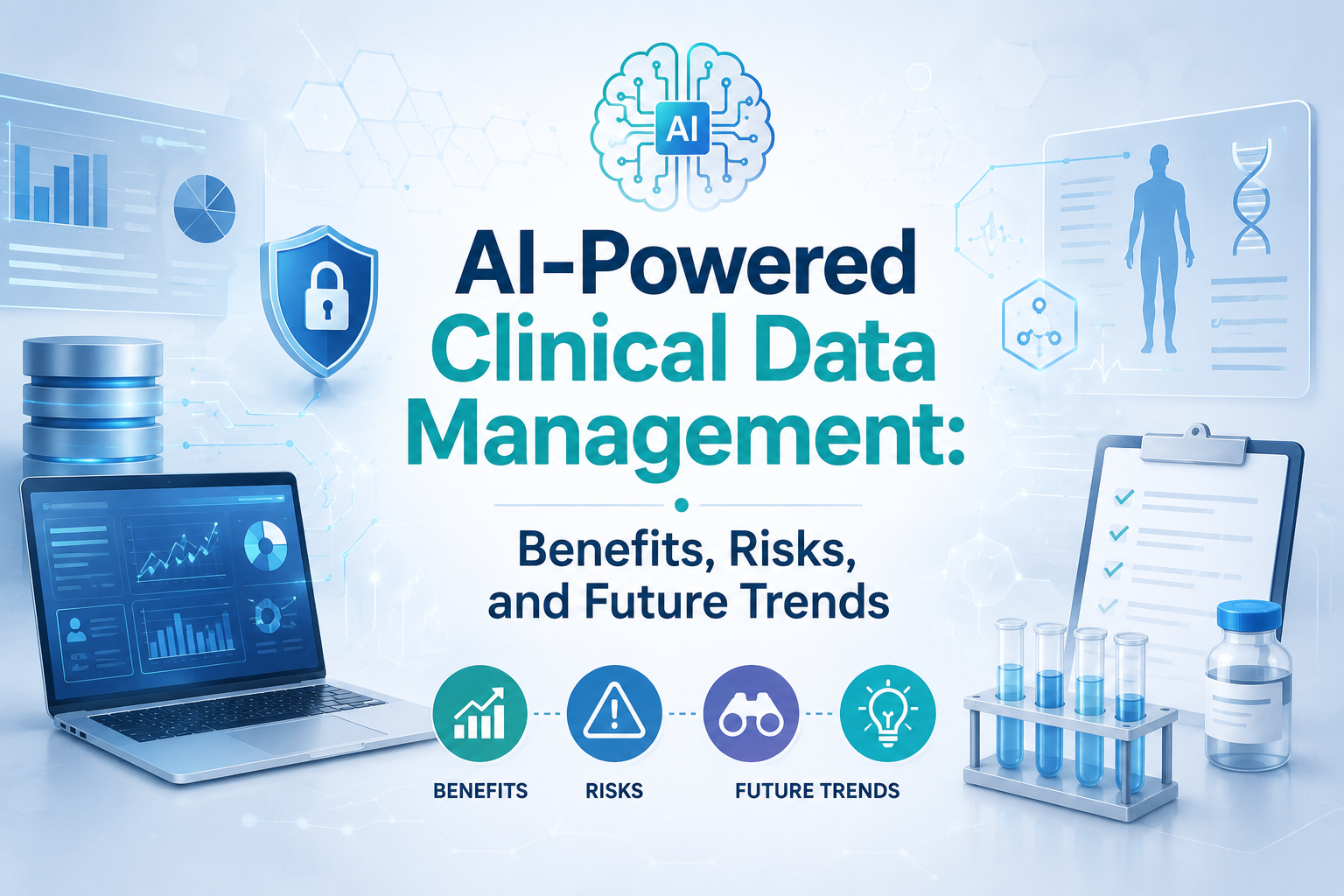
AI-powered clinical data management is transforming how pharmaceutical companies, contract research organizations (CROs), and healthcare institutions collect, process, validate, and analyze data across clinical trials. As the volume and complexity of clinical research data grow exponentially, artificial intelligence is no longer a futuristic concept — it is an operational necessity.
This guide explores what AI in clinical data management means in practice, the measurable benefits it delivers, the risks that must be managed, and the emerging trends shaping the next decade of clinical research.
What Is AI-Powered Clinical Data Management?
Clinical data management (CDM) refers to the systematic process of collecting, cleaning, integrating, and validating data generated during clinical trials to ensure accuracy, completeness, and regulatory compliance. Traditionally, this has been a heavily manual, error-prone, and time-consuming function.
AI-powered clinical data management applies machine learning (ML), natural language processing (NLP), and intelligent automation to these processes — enabling faster data cleaning, smarter query resolution, predictive validation, and real-time monitoring across multi-site trials.
At its core, AI in clinical data management does three things:
- Automates repetitive tasks such as data entry validation, query generation, and coding
- Identifies patterns and anomalies that human reviewers may miss
- Accelerates decision-making by delivering actionable insights in real time
Organizations like Weltrix are integrating AI-driven workflows into their CRO data management services, enabling sponsors to reduce database lock timelines and improve data quality without inflating operational costs.
The State of AI in Clinical Research: Key Industry Data
Before exploring benefits and risks, it helps to understand the scale of the problem AI is solving:
- Clinical trial data volume has grown 400% over the past decade, according to industry benchmarks
- Data management and cleaning account for up to 30% of total trial costs
- Manual data entry errors remain one of the leading causes of trial delays and FDA audit findings
- The global clinical data management market is projected to exceed $3.5 billion by 2030, driven significantly by AI adoption
These figures illustrate why AI for clinical research is not a convenience — it is a competitive and regulatory imperative.
Key Benefits of AI in Clinical Data Management
1. Accelerated Data Cleaning and Validation
One of the most resource-intensive phases of clinical trial data management is data cleaning — identifying and resolving discrepancies, missing values, and protocol deviations. AI-driven clinical data management systems can:
- Run automated edit checks across thousands of data points in seconds
- Flag anomalies based on statistical patterns learned from previous trials
- Prioritize queries by risk level so data managers focus on what matters most
This dramatically reduces the time to database lock — a critical milestone that determines how quickly sponsors can submit regulatory packages.
2. Intelligent Query Management
In traditional CDM workflows, query resolution between sites and data managers is slow, often fragmented, and dependent on manual tracking. AI-powered electronic data capture (EDC) systems can now auto-generate, route, and resolve queries with minimal human intervention.
Machine learning models trained on historical query patterns can predict which data fields are most likely to generate errors — allowing proactive validation before data is even submitted. This shifts the paradigm from reactive query resolution to predictive data quality management.
3. Automated Medical Coding
Medical coding — mapping clinical terms to standardized dictionaries like MedDRA and WHO Drug Dictionary — is critical for regulatory submissions. Manual coding is time-consuming and subject to coder variability.
AI tools using NLP can auto-suggest codes with high accuracy, significantly reducing the burden on medical coders and improving consistency across multi-regional trials. This is one of the most concrete examples of clinical data automation delivering immediate ROI.
4. Enhanced Risk-Based Monitoring
AI enables sophisticated risk-based monitoring (RBM) by continuously analyzing site-level data patterns and flagging sites that deviate from expected performance. Instead of routine on-site visits that are costly and logistically complex, sponsors can direct monitoring resources to the highest-risk sites.
Weltrix’s biometrics for clinical trials approach incorporates data-driven monitoring strategies that integrate statistical signals with site performance metrics — a model increasingly reliant on AI-powered analytics.
5. Faster Regulatory-Ready Reporting
Generating CDISC-compliant datasets (SDTM, ADaM) for regulatory submission has historically required significant manual effort and specialized expertise. AI tools can automate CDISC mapping, validate dataset structure against submission standards, and flag compliance gaps before submission — compressing timelines by weeks or months.
6. Improved Patient Safety Signal Detection
AI algorithms can monitor incoming trial data in near real-time for early safety signals — detecting adverse event patterns across sites before they escalate. This is particularly valuable in large, multi-arm studies where human review alone cannot keep pace with data volume.
Comparison: Traditional vs. AI-Powered Clinical Data Management
| Capability | Traditional CDM | AI-Powered CDM |
| Data validation | Manual edit checks | Automated, ML-driven validation |
| Query management | Manual tracking and resolution | Auto-generation and predictive resolution |
| Medical coding | Human coders, high variability | NLP-assisted, consistent, scalable |
| Site monitoring | Schedule-based on-site visits | Risk-based, data-driven remote monitoring |
| CDISC compliance | Manual mapping and review | Automated mapping with gap detection |
| Database lock timeline | Weeks to months | Days to weeks |
| Safety signal detection | Periodic medical review | Real-time pattern detection |
| Scalability | Linear resource scaling | Exponential without proportional cost increase |
Risks of AI in Healthcare Data Management
AI adoption in clinical research is not without significant risks. Sponsors, CROs, and regulators must understand these risks to implement AI responsibly.
1. Data Quality and Bias in Training Data
AI models are only as good as the data they are trained on. If training datasets are incomplete, unbalanced, or drawn from non-representative patient populations, the model’s outputs will reflect those biases — potentially affecting clinical conclusions and regulatory decisions.
Mitigation: Require vendors to document model training data provenance, validation datasets, and performance metrics across demographic subgroups.
2. Regulatory Uncertainty and Auditability
The FDA, EMA, and other regulators are still developing comprehensive guidance for AI use in clinical data management. A key concern is explainability — can sponsors demonstrate to auditors exactly how an AI system made a specific decision that influenced trial data?
“Black box” models that cannot explain their reasoning create compliance risk in regulated environments. Sponsors should prioritize AI solutions with transparent, auditable decision trails.
3. Overreliance and Automation Bias
When clinical data teams become overly dependent on AI outputs, human oversight deteriorates. This “automation bias” can lead to errors going undetected if staff assume the AI has already caught them. AI should augment human expertise — never replace it entirely in safety-critical functions.
4. Cybersecurity and Data Privacy
Clinical trial data contains highly sensitive patient information. AI systems that process this data create additional attack surfaces, particularly when integrated with cloud-based EDC platforms or third-party analytics tools.
Compliance with GDPR, HIPAA, and ICH E6(R2) GCP standards must be explicitly addressed in vendor contracts and system validation documentation.
5. System Validation and Change Control
In GCP-regulated environments, any software used to process clinical trial data must be validated according to GAMP 5 or equivalent standards. AI systems that learn and update continuously pose a unique challenge: validating a model that changes over time requires new frameworks that the industry is still developing.
AI in Pharmaceutical Research: Practical Applications Beyond Data Management
AI’s impact on pharmaceutical research extends beyond CDM workflows:
- Protocol design optimization: AI analyzes historical trial data to recommend inclusion/exclusion criteria that improve recruitment and reduce dropout rates
- Site selection: Predictive models score investigator sites based on historical performance, patient population fit, and operational readiness
- Patient recruitment: NLP tools analyze electronic health records (EHR) to identify eligible patients at scale
- Biomarker identification: ML models analyze multi-omics data to identify predictive biomarkers for patient stratification
These applications are reshaping clinical trial strategy, not just operations. Sponsors working with experienced CRO partners — such as those offering integrated biostatistics services for clinical research — are better positioned to connect AI-generated insights with rigorous statistical validation.
Future Trends in AI-Driven Clinical Data Management
1. Real-World Data Integration
Regulators are increasingly accepting real-world evidence (RWE) to supplement or replace traditional trial arms. AI will be essential for cleaning, harmonizing, and analyzing the messy, heterogeneous data from EHRs, wearables, and patient registries — making RWE generation faster and more reliable.
2. Decentralized Clinical Trial (DCT) Data Management
The shift toward decentralized and hybrid trials generates data from multiple sources simultaneously — remote monitoring devices, ePRO systems, telehealth platforms. AI is the only scalable solution for integrating and validating this data in real time.
3. Large Language Models (LLMs) in CDM Workflows
LLMs are beginning to be applied to narrative adverse event coding, protocol deviation review, and medical writing support. While still nascent in regulated environments, this represents the next frontier of AI in clinical research — where AI handles not just structured data but unstructured clinical narratives.
4. AI-Augmented CDISC Compliance
Next-generation CDM platforms will embed AI directly into CDISC mapping workflows, automatically suggesting and validating dataset structure as data is collected — rather than requiring a separate mapping exercise at the end of a trial.
5. Federated Learning for Multi-Sponsor Research
Federated learning allows AI models to train on data distributed across multiple organizations without centralizing sensitive patient data. This has profound implications for pre-competitive collaboration in areas like rare disease research, where no single sponsor has sufficient data volume.
For sponsors seeking to implement these capabilities with regulatory rigor, Weltrix’s clinical data management services are designed to bridge cutting-edge AI tools with established GCP compliance frameworks.
Best Practices for Implementing AI in Clinical Data Management
- Start with validated use cases — Apply AI first to high-volume, rule-based tasks like edit check automation before moving to more complex applications
- Maintain human oversight loops — Define clear escalation criteria where human data managers must review and approve AI-generated decisions
- Document everything — Create a comprehensive AI validation master plan aligned with 21 CFR Part 11 and Annex 11 requirements
- Audit model performance continuously — Track accuracy, false positive rates, and drift over time across trial types
- Train your team — AI tools are only effective when clinical data managers understand their capabilities and limitations
- Engage your regulator early — For novel AI applications, consider regulatory consultation to avoid late-stage surprises
Frequently Asked Questions (FAQ)
What is AI-powered clinical data management?
AI-powered clinical data management is the application of artificial intelligence technologies — including machine learning, natural language processing, and intelligent automation — to the collection, validation, cleaning, coding, and analysis of clinical trial data. It accelerates timelines, improves data quality, and reduces the manual burden on CDM teams.
How does AI improve clinical trial data management?
AI improves clinical trial data management by automating edit checks and query generation, predicting data quality issues before they occur, accelerating medical coding through NLP, enabling real-time risk-based monitoring, and streamlining CDISC-compliant dataset preparation for regulatory submission.
What are the risks of using AI in clinical data management?
Key risks include model bias from unrepresentative training data, regulatory uncertainty around AI explainability and auditability, automation bias leading to reduced human oversight, cybersecurity vulnerabilities in AI-integrated platforms, and the challenge of validating continuously learning systems under GCP regulations.
Is AI in clinical data management compliant with FDA regulations?
AI tools used in clinical data management must comply with 21 CFR Part 11 (electronic records), ICH E6(R2) GCP guidelines, and applicable GAMP 5 validation standards. The FDA has issued emerging guidance on AI/ML-based software in regulated settings, and sponsors must ensure any AI system used in clinical trials has a documented validation package and audit trail.
What is the difference between EDC and AI-powered CDM?
Electronic data capture (EDC) is a technology platform for collecting clinical trial data electronically. AI-powered CDM builds on EDC by adding intelligent layers for predictive validation, automated query management, and risk-based monitoring. AI does not replace EDC — it enhances it.
How does AI help with medical coding in clinical trials?
AI uses natural language processing to automatically map clinical terms to standardized medical coding dictionaries such as MedDRA and WHO Drug Dictionary. This reduces coding time, improves cross-coder consistency, and flags ambiguous terms for human review — without replacing the qualified medical coder responsible for final approval.
Can AI be used in decentralized clinical trials?
Yes. AI is particularly valuable in decentralized clinical trials (DCTs) because it can integrate and validate data from multiple sources simultaneously — including wearables, ePRO platforms, and remote monitoring devices — in near real time. Without AI, managing the data complexity of DCTs at scale is operationally impractical.
What should sponsors look for in an AI-powered clinical data management vendor?
Sponsors should evaluate vendors on: documented model validation and training data transparency, regulatory compliance track record (21 CFR Part 11, GCP), integration with existing EDC and CTMS platforms, explainability of AI decisions for audit purposes, and demonstrated experience across therapeutic areas and trial phases.
Conclusion
AI-powered clinical data management represents a fundamental shift in how the pharmaceutical and biotech industry generates, manages, and submits clinical evidence. The benefits — faster timelines, higher data quality, smarter monitoring — are well-documented and increasingly expected by sponsors and regulators alike.
But the path to AI adoption in a GCP-regulated environment requires more than technology. It requires validated systems, trained teams, transparent processes, and experienced partners who understand both the science and the regulatory context.
Organizations like Weltrix bring together clinical data management expertise, biometrics capabilities, and AI-informed workflows under a single integrated CRO model — helping sponsors navigate this transition with confidence and compliance.
As artificial intelligence continues to evolve, the question for clinical research organizations is no longer whether to adopt AI — it is how to do so responsibly, rigorously, and at scale.
Leave A Comment