
 By Weltrix
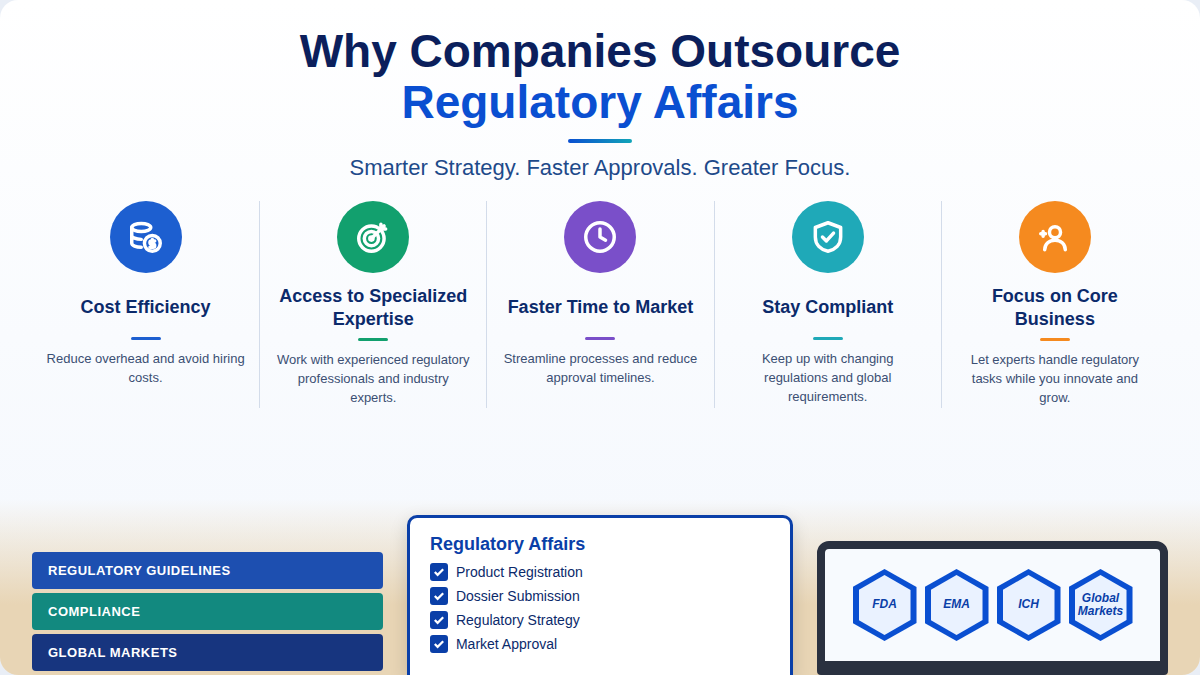
Companies outsource regulatory affairs for a handful of practical reasons. It turns a fixed cost into a variable one. It gives them expertise that would take years to build in-house. It helps them avoid submission mistakes that restart the review clock. It lets them handle workload swings, and it keeps their own people focused on the work that actually makes the company money. If you’re a pharma or biotech company with no regulatory team, this is less a budget call than a decision about how the company is built.
It usually starts with something specific. Your first-in-human study is eighteen months away and nobody on staff has ever run a pre-IND meeting. Or a partner asks when you can submit, and the honest answer is “no idea.” That’s where most companies begin looking at outsourcing, not with a cost-benefit spreadsheet.
Quick Summary
| Reason | What changes |
| Cost | Fixed headcount becomes project-based spend |
| Expertise | You get people whose full-time job is tracking guidance changes |
| Speed | Fewer avoidable errors and fewer wasted review cycles |
| Flexibility | Capacity follows your pipeline, not your org chart |
| Focus | Your science and commercial teams stay on their own work |
1. The Cost Argument Is About How Costs Are Set Up, Not Just Saving Money
An in-house regulatory team is a fixed cost. You pay for salaries, benefits, training, database subscriptions and publishing software. None of that shrinks between submissions, and if you only have one asset in the clinic, you’re paying for a lot of idle time.
Outsourcing ties your spend to actual activity. That helps most if you’re:
- A company with a single programme moving through phases
- A sponsor entering a new market for the first time
- An organisation with project-based or seasonal regulatory work
Some costs are set by law, and they’re worth planning around. FDA’s FY 2027 prescription drug user fee rates take effect on 1 October 2026. The application fee is $4,600,753 for an application that needs clinical data and $2,300,376 for one that doesn’t. With numbers like that, the question isn’t whether to spend on regulatory expertise. It’s where.
Small businesses submitting their first human drug application may qualify for a fee waiver. An experienced regulatory partner will bring that up before the invoice arrives, not after.
2. Expertise Goes Out of Date
Regulatory knowledge goes stale fast. Someone who was fully up to speed three years ago isn’t anymore, unless keeping up is their whole job.
Here’s a recent example. In August 2026, FDA finalised its guidance on formal meetings between the agency and sponsors of PDUFA products. It replaced a draft that had been sitting open since September 2023, and it added Type D and INTERACT meetings to the four types sponsors had used for years. A team that learned the 2017 framework and stopped reading is now picking meeting types that no longer match what they need.
Outsourcing partners typically cover:
- Rules across FDA, EMA, MHRA, PMDA and CDSCO
- Submission format requirements, including eCTD structure and validation
- Data standards requirements under the FDA Data Standards Catalog
- Post-approval reporting and lifecycle commitments
Few mid-size sponsors can cover all of that internally, and not many large ones can either. That’s why even well-staffed regulatory departments buy in outside help for markets they rarely enter.
3. Speed Comes From Fewer Wasted Cycles
You’ll often hear that outsourced teams move faster because of their relationships with regulators. That’s not true. Agencies don’t do favours, and anyone selling you that line should make you a bit suspicious.
What really saves time is less exciting: asking the right question, through the right channel, at the right stage. FDA sorts sponsor meetings into categories with set timelines, and picking the wrong one costs you weeks.
| Meeting type | Typical use | Agency scheduling goal |
| Type A | Stalled programme or clinical hold | Within 30 days |
| Type B | Pre-IND, end-of-phase, pre-NDA/BLA | Within 60 days |
| Type C | Anything outside the other categories | Within 75 days |
| Type D | Narrow set of critical issues | Within 50 days |
| INTERACT | Early questions on novel products | Within 75 days |
If you send a narrow question through a Type C request, you wait 75 days for an answer a Type D would have given you in 50. If you send an incomplete package, the meeting gives you nothing useful. Submissions work the same way. A filing with technical gaps uses up a review cycle without getting reviewed.
4. Capacity That Fits Your Pipeline
Regulatory work comes in waves. You have a pre-IND meeting, then it goes quiet. Then a marketing application, then quiet again. A team built for the peak sits idle in between, and a team built for the average can’t cope when the peak hits.
Outsourcing lets you:
- Add capacity for a big submission without hiring permanently
- Scale back down without a restructure
- Bring in narrow expertise for a single market entry
This hits hardest if you’re running several assets at different stages, because the busy periods rarely line up neatly. One programme’s response to an information request lands in the same two weeks as another’s annual report, and both have deadlines.
5. Your Own Team Stays on Their Own Work
Regulatory affairs matters a lot, but for most companies it isn’t where the value comes from. Every hour a clinical lead spends chasing a formatting requirement is an hour they’re not spending on the protocol.
Handing it off frees your scientific and commercial people to focus on development, market strategy and pipeline decisions. It’s a deliberate trade: the specialised execution goes outside, and the judgement about which programmes to pursue stays with you.
In-House vs Outsourced: Where Each One Wins
| Factor | In-house team | Outsourced |
| Cost | Fixed | Variable, tied to activity |
| Range of expertise | Limited to who you hired | Specialists across regions and product types |
| Institutional memory | Strong | Depends on how stable the partner’s team is |
| Speed of scaling | Slow, tied to hiring | Fast |
| Best fit | Steady, high-volume submissions | Uneven workloads, first submissions, new markets |
Most comparisons skip institutional memory, and it’s where outsourcing really does cost you something. An in-house team remembers why a commitment was worded a certain way back in 2023. The best fix is to write continuity of personnel into the contract.
What Outsourcing Doesn’t Hand Over
Accountability. ICH E6(R3) is clear that a sponsor can pass trial-related duties to a service provider but stays responsible for the quality and integrity of the data. Regulators hold the applicant accountable, and no contract changes that.
In practice, you still need enough regulatory know-how in-house to review what your partner produces and ask good questions. Usually that means one experienced person who owns the relationship, reads the deliverables properly and can tell when an answer is thin. Without that person, you’re not delegating. You’re just hoping.
Weltrix works with sponsors on regulatory affairs services, including submission planning, module authoring and FDA meeting preparation. We also handle the biometrics deliverables that feed the clinical sections of a dossier.
Frequently Asked Questions
Q. What does a regulatory affairs outsourcing company do?
It prepares and publishes submissions, writes dossier sections, handles correspondence and meeting requests with agencies, tracks regulatory changes that affect your programme, and keeps up with post-approval reporting in your target markets.
Q. Is outsourcing regulatory affairs only for small companies?
No. Small and mid-size sponsors outsource because they can’t justify a full-time team. Large companies do it for extra capacity, unfamiliar markets, or product types their own team hasn’t dealt with before.
Q. How much does it cost to outsource regulatory affairs?
Pricing is usually per project or on a retainer. The range depends on scope, target markets and how complex the product is. The right comparison is against the full cost of in-house specialists plus software and database subscriptions, not just salaries.
Q. Can an outsourced team handle submissions in multiple countries?
Yes, and that’s a common reason to outsource. Requirements differ a lot by region, especially in the administrative and regional sections of a dossier. A partner with regional specialists saves you from building separate in-house capability for each market.
Q. Does outsourcing regulatory affairs transfer regulatory responsibility?
No. You can delegate duties to a service provider, but the sponsor or applicant is still accountable to regulators for the submission and for data quality and integrity. ICH E6(R3) says this directly.
Q. What should companies look for in a regulatory affairs partner?
Look for a track record in your product category and target markets, named people who’ll stay with your programme, clear ownership of publishing and validation, and a documented way of tracking guidance changes that affect your filings.
Key Takeaways
- Outsourcing swaps fixed headcount for spend that follows your activity.
- FDA’s FY 2027 application fee is $4,600,753 when clinical data is required, which shows how much good regulatory advice is worth.
- Regulatory knowledge goes stale. FDA finalised its formal meetings guidance in August 2026 and added meeting types that didn’t exist in the 2017 framework.
- Speed comes from choosing the right meeting type and submitting complete packages, not from agency relationships.
- The real cost of outsourcing is lost institutional memory, and keeping the same people on your programme is the fix.
- Under ICH E6(R3), duties can move to a service provider but accountability stays with you.
You still need enough in-house knowledge to review what your partner deliv
Leave A Comment