
 By Weltrix
Most teams do not discover a data quality problem. They discover a wrong answer, then trace it backwards.
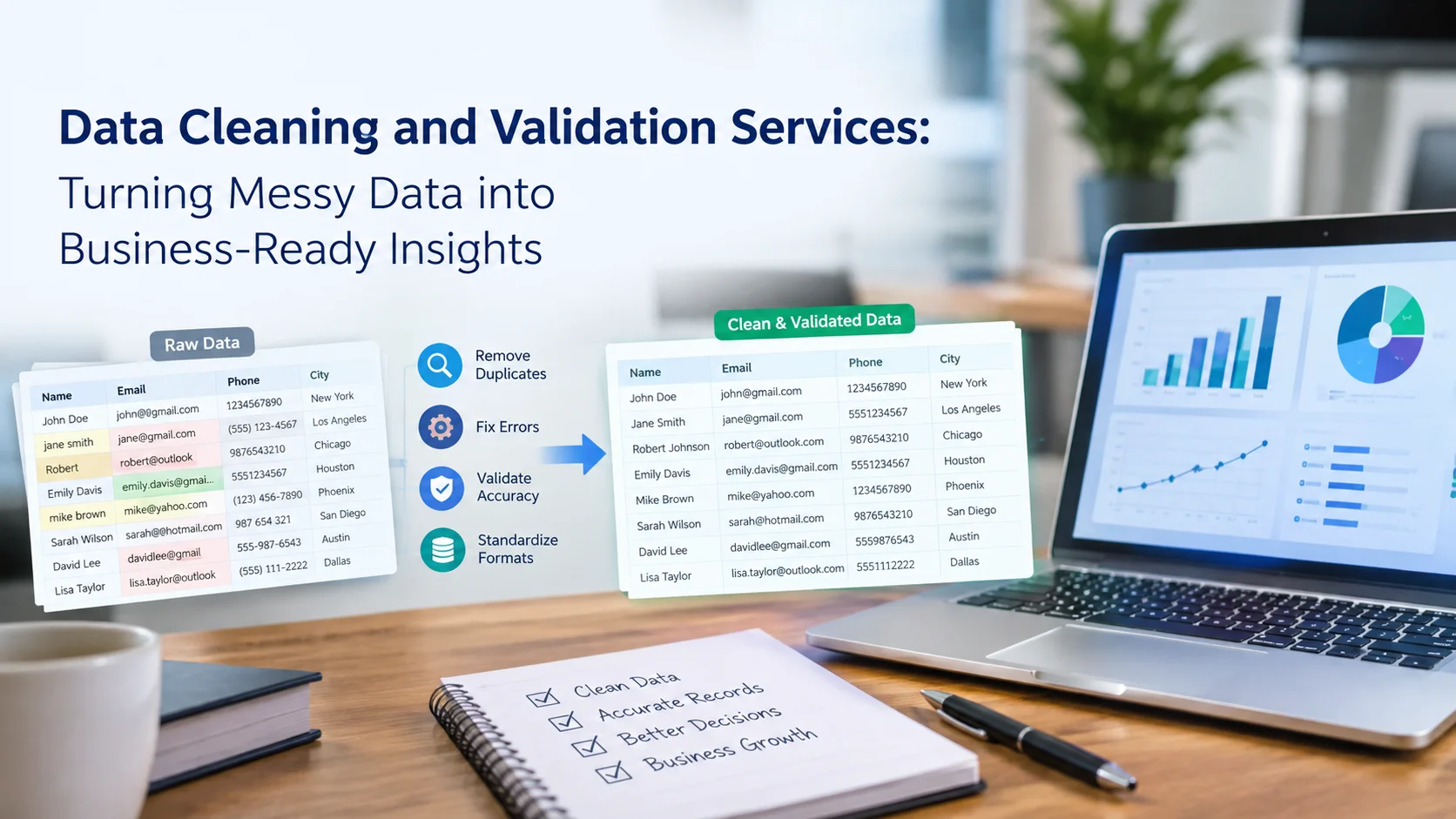
The forecast misses. A model trained on twelve months of records returns a recommendation nobody can reproduce. The dataset looked fine in the dashboard, because dashboards render whatever they are handed. Data cleaning and validation services exist to catch these failures at entry rather than at the point of decision.
Cleaning and Validation Are Two Different Jobs
The terms get used interchangeably. Confusing them is how teams end up with tidy data that is still wrong.
| Data cleaning | Data validation | |
| Question answered | Is this record correct? | Does this record meet our rules? |
| Typical actions | Deduplication, standardisation, typo correction, missing values | Range, logic, mandatory field, and referential integrity checks |
| When it runs | On existing datasets, in batch | At entry, then continuously |
| Output | A corrected dataset | A pass, a fail, or a query |
| Fails silently? | Often | Rarely, by design |
Cleaning is remedial. Validation is preventive. Mature data quality management runs both, with the ratio shifting toward validation over time.
Define What “Good” Means Before You Start
“Clean data” is not a specification. Most data quality frameworks break the idea into dimensions you can measure separately, which matters because a dataset can score well on one and fail badly on another.
| Dimension | What it measures | Example of failure |
| Completeness | Are required values present? | Blank country field on 12% of accounts |
| Accuracy | Does the value match reality? | Address correct in format, wrong in fact |
| Consistency | Do systems agree? | CRM and billing show different statuses |
| Validity | Does the value fit the allowed set? | A date of 2024-13-01 |
| Uniqueness | Is each entity represented once? | Three records for one customer |
| Timeliness | Is the value current enough to use? | Employment data eighteen months stale |
Accuracy is the expensive one. Validity, completeness, and uniqueness can be tested with rules. Accuracy cannot be checked from inside the dataset at all, and needing an external reference is why it is the dimension most programmes quietly skip.
What Poor Data Quality Actually Costs
Figures in this space get recycled without attribution, so here is one with a named source. Gartner puts the average annual cost of poor data quality at $12.9 million per organisation, from 2020 research. Gartner also names inconsistency across sources as the hardest data quality problem organisations face, which points at silos rather than sloppiness.
The cost rarely arrives as one event. It accumulates in rework, in hours spent reconciling two versions of the same number, and in decisions that were reasonable given the inputs and wrong given reality.
The Six Errors That Account for Most of the Damage
| Issue | What it looks like | Downstream effect |
| Duplicate records | Same entity under two IDs | Inflated counts, broken attribution |
| Missing values | Empty required fields | Skewed averages, dropped rows |
| Inconsistent formatting | Dates and addresses stored differently | Failed joins, false non-matches |
| Outdated information | Stale contact or status data | Wasted spend, compliance exposure |
| Entry errors | Typos, transposed digits, wrong units | Outliers that pass unnoticed |
| Structural errors | Type mismatches, broken keys | Silent data loss on integration |
The last one deserves attention. Structural errors do not announce themselves. A broken join drops rows quietly, and the analysis still looks complete.
The Process, Step by Step
A professional data cleansing engagement follows a repeatable sequence. Each stage should produce something reviewable.
| Step | Activity | Deliverable |
| 1 | Data audit and profiling | Issue inventory with counts and severity |
| 2 | Standardisation | Agreed format rules, applied |
| 3 | Deduplication | Match rules and a merge log |
| 4 | Correction and enrichment | Corrected fields, source of truth noted |
| 5 | Validation rules applied | Rule set plus exception report |
| 6 | QA and reporting | Change log and residual issue list |
Step 3 is where judgement matters most. Automated matching handles obvious duplicates and struggles with the ambiguous middle. Set the threshold too loose and you merge distinct customers. Too tight, and you keep the duplicates you paid to remove.
Step 4 carries a different risk. Enrichment from third-party sources fills gaps quickly and imports someone else’s error rate into a dataset you are accountable for. Record where each enriched value came from. In six months nobody will remember which fields were observed and which were inferred.
Where Compliance Enters the Picture
Data accuracy carries legal weight in several regimes, though the obligations are narrower than “regulations require clean data” suggests:
- GDPR. Article 5(1)(d) of Regulation (EU) 2016/679 requires personal data to be accurate and kept up to date, with inaccurate data erased or rectified without delay. Article 16 gives individuals a matching right to rectification
- HIPAA. 45 CFR 164.526 lets individuals request amendment of protected health information they believe is inaccurate or incomplete, with defined obligations on the covered entity to respond
- CCPA, as amended by CPRA. Section 1798.106 establishes a consumer right to correct inaccurate personal information
None mandate a cleaning programme outright. All become hard to satisfy without one, because you cannot rectify a record you cannot locate across systems.
Clinical Research Sets a Higher Bar
In regulated trials, data quality is not an efficiency argument. It determines whether a dataset can support a regulatory conclusion at all.
ICH E6(R3), adopted at Step 4 on 6 January 2025 and effective in the EU from 23 July 2025, added a dedicated data governance section spanning capture, metadata, audit trails, access control, corrections, and retention. Every change to a data point needs a record of who changed it, when, and why.
That reshapes the work. Edit checks go into the EDC system before first patient in. Validation logic is specified during database design and build, because a check written into the database beats a query raised three months later. Weltrix runs this within its clinical data management services, where cleaned and locked datasets feed biostatistics and analysis.
The sequencing is the point. Discrepancies surface as queries while the study is running and source documents are at hand, rather than as a reconciliation exercise before database lock. Corrections are attributed and time-stamped, so an inspector reading the audit trail two years later can reconstruct how a value reached its final state.
Commercial teams borrow from this model more than they used to. Build checks in at capture, and the cleaning backlog shrinks on its own.
Choosing a Provider: Questions Worth Asking
- What does the issue inventory look like before any changes are made?
- How are ambiguous duplicate matches resolved, and who reviews them?
- What is retained as an audit trail, and for how long?
- Which parts are automated, and where does a human check the output?
- What do you hand back besides the cleaned file?
A provider who cleans once leaves you a dataset that starts degrading immediately. The useful engagement ends with rules and monitoring in place, not just a corrected export.
Frequently Asked Questions
What is the difference between data cleaning and data validation?
Data cleaning corrects existing errors: duplicates, typos, inconsistent formats, missing values. Data validation applies rules to check that data meets required formats, ranges, and logical conditions, ideally at entry. Cleaning fixes what went wrong. Validation prevents it.
How often should businesses clean their data?
It depends on how fast new data arrives and how quickly it decays. Contact and account data typically warrants monthly or quarterly cycles. Continuous validation on incoming records matters more than the batch interval, since prevention costs less than remediation.
Can data cleaning be automated?
Partly. Deduplication, format standardisation, and rule-based checks automate well. Ambiguous matches and context-dependent corrections still need human review, since an automated merge of two distinct records is harder to detect than the duplicate it replaced.
Is data cleaning worth it for small businesses?
Yes. Small datasets carry the same error types as large ones, and the effect on decisions is proportionally larger when there is less data to average errors out.
How does data quality affect AI and machine learning models?
Models learn the patterns in training data, errors included. Duplicates skew class balance, missing values force imputation assumptions, and inconsistent labels cap achievable accuracy regardless of architecture. Validation before training is cheaper than diagnosing model behaviour afterwards.
What are the dimensions of data quality?
Most frameworks use completeness, accuracy, consistency, validity, uniqueness, and timeliness. Rules can test all of them except accuracy, which requires comparison against an external source of truth, making it the hardest and most often neglected dimension.
What does data validation mean in a clinical trial?
It means applying pre-specified edit checks to trial data as it is captured, raising queries on discrepancies, and documenting every correction with an audit trail. ICH E6(R3) sets the data governance expectations across the full lifecycle.
Conclusion
Data quality work is unglamorous and it compounds. Organisations that get value from it stop treating cleaning as a project and start treating validation as infrastructure: rules written down, checks running at capture, someone accountable for the exception report. Start with an audit of one system you actually make decisions from. The issue inventory usually settles the business case on its own.
Key Takeaways
- Cleaning corrects existing errors, validation prevents new ones, and mature programmes shift effort toward validation
- Gartner puts the average annual cost of poor data quality at $12.9 million per organisation
- Structural errors are the most dangerous category, because broken joins drop records without visible failure
- Over-merging duplicates is harder to detect than under-merging, so match thresholds need human review
- GDPR Article 5(1)(d), HIPAA 45 CFR 164.526, and CCPA section 1798.106 attach legal consequences to inaccurate personal data
- ICH E6(R3) added a dedicated data governance section covering capture, audit trails, corrections, and retention
- Accuracy is the only quality dimension that cannot be tested from inside the dataset
- A one-time clean without ongoing rules leaves you back where you started
Leave A Comment