
 By Weltrix
Your submission can fail before a reviewer opens a single document.
When a package reaches FDA’s Electronic Submissions Gateway, an automated validation pass runs against it. If a required dataset is missing from Module 5, the gateway returns a rejection acknowledgement and the science inside never gets read. Publishing feels like a formatting step. It behaves like a scientific deliverable with its own failure modes.
What an eCTD Submission Actually Is
The electronic Common Technical Document is an XML-backboned dossier built on the ICH-harmonised CTD structure. That backbone indexes every document, records its lifecycle operation, and tells the agency where each file sits in the module tree.
FDA phased in mandatory use: NDAs, ANDAs and BLAs from 5 May 2017, commercial INDs and master files from 5 May 2018. In-scope submissions arriving in another format are not filed or received.
One version note. FDA has supported eCTD v4.0 for new NDA, BLA, ANDA, IND and MF applications since 16 September 2024, while v3.2.2 remains in use. Forward compatibility is not yet available.
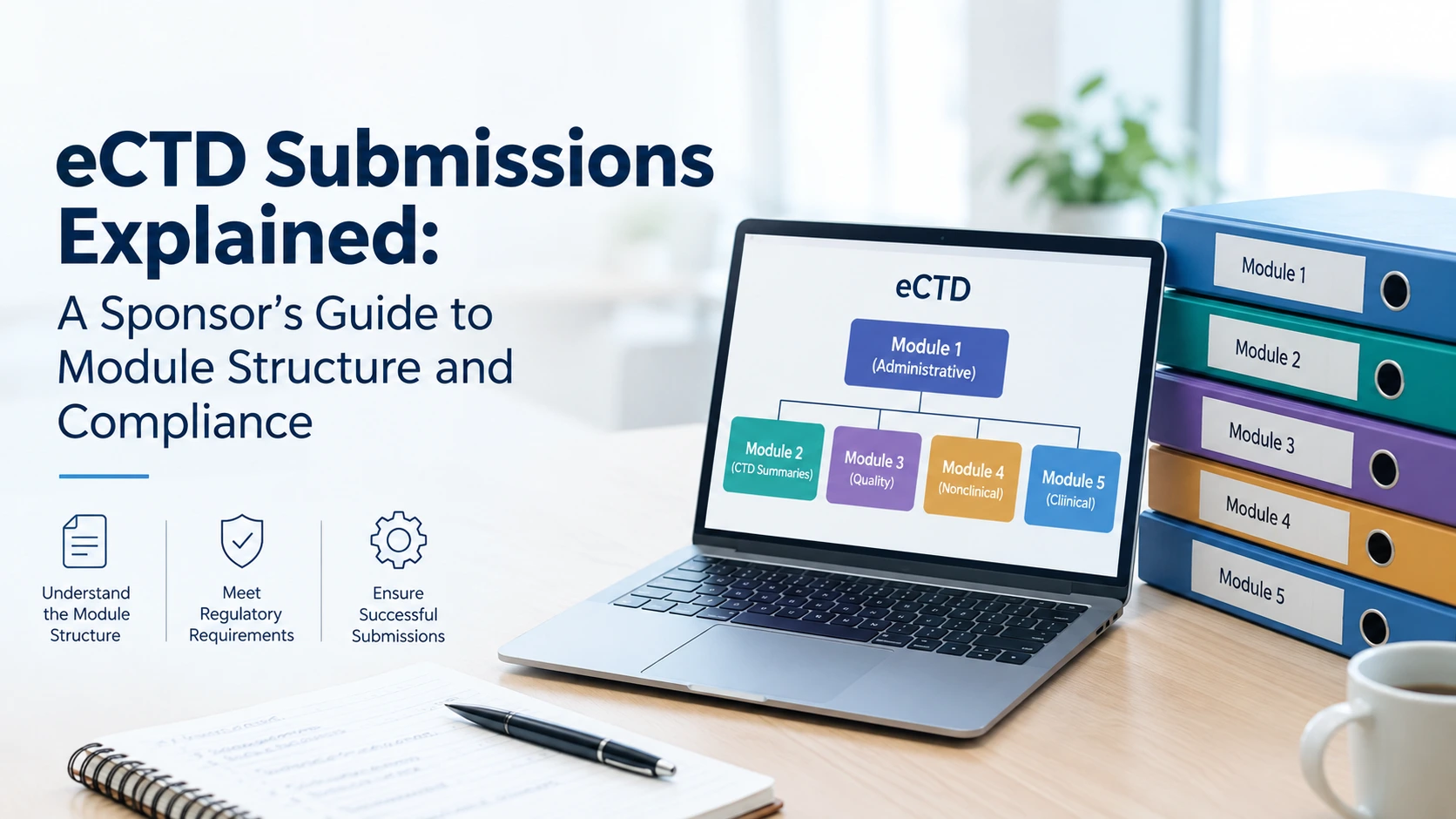
The Five Modules, and What Belongs in Each
| Module | Contents | Regional variation | Typical owner |
| 1 | Cover letters, forms, labeling, regional correspondence | Region-specific | Regulatory affairs |
| 2 | CTD summaries: quality, nonclinical, clinical | Harmonised | Medical writing |
| 3 | Quality and CMC data | Harmonised | CMC |
| 4 | Nonclinical study reports, SEND datasets | Harmonised | Toxicology |
| 5 | CSRs, SAP, SDTM and ADaM datasets, define.xml | Harmonised | Biometrics |
Module 1 is where regional strategy lives. The rest is common in structure, though the data standards expectations attached to Modules 4 and 5 are where most technical failures start.
Where Submissions Actually Get Rejected
FDA publishes the validation codes it enforces. Read them before you build a timeline. They check for things clinical teams tend to assume are handled downstream.
| Code | What it checks | Severity |
| 1789 | A valid Study Tagging File is present | High |
| 1734 | A ts.xpt dataset with study start date exists for each study | High |
| 1735 | Correct STF file tags used for standardised datasets and define.xml | High |
| 1736 | DM plus define.xml in Module 4 for SEND, in Module 5 for SDTM; ADSL plus define.xml for ADaM | High |
Two details change how you plan around this.
The checks run sequentially, starting at 1789. Validation stops at the first failure, which means one error hides everything behind it. CDER began rejecting submissions on these criteria in September 2021, with CBER nonclinical sections following in March 2023.
The trigger is study start date. Standards in the FDA Data Standards Catalog apply to studies beginning on or after 17 December 2016 for NDAs, ANDAs and BLAs, and 17 December 2017 for commercial INDs. Legacy studies predating those cutoffs carry different obligations, and mixed applications need deliberate handling.
Regional Routing Is Not Interchangeable
| Region | Channel | Format position |
| US (FDA) | Electronic Submissions Gateway | eCTD mandatory for in-scope applications |
| EU centralised | EMA eSubmission Gateway / Web Client | eCTD required; CDs and CESP dropped for centralised procedures in July 2015 |
| EU MRP / DCP / national | Common European Submission Portal, run by HMA | Separate system, not connected to EMA’s gateway |
| India (CDSCO) | SUGAM portal | CTD-based dossiers submitted through the portal |
A common error is treating CESP as EMA infrastructure. It is not. Centralised applications routed there will not reach the reviewers you intend.
Five Failure Patterns That Repeat
- Late conformance checking. Validation run in submission week turns a fixable programming issue into a schedule problem
- Terminology drift between Module 2 and Module 5. Study identifiers and dosing language that differ across modules generate queries
- Publishing time treated as buffer. Two to four weeks of dedicated publishing and validation, on top of document finalisation
- Broken internal hyperlinks. CSR to SAP, summary to source table. Their absence gets noticed
- Incorrect lifecycle operators. A replace filed as an append leaves the current version ambiguous
Building Backwards From the Filing Date
Sponsors who clear validation first time run publishing as a parallel track, not a closing step. Three habits show up consistently:
- Trial Summary content, study start date included, gets populated during study conduct rather than at submission
- Conformance checks run on a rolling basis against draft SDTM and ADaM outputs
- Module 2 authoring starts while clinical data is still being cleaned, so narrative and datasets share the same assumptions
For teams without in-house publishing capability, the coordination between biometrics and regulatory is usually the gap. Weltrix supports sponsors with regulatory affairs services covering eCTD submission planning and module authoring, alongside the statistical programming that produces Module 5.
Frequently Asked Questions
Q. What is eCTD in clinical trials?
eCTD is the XML-based format agencies use to receive drug and biologic applications. It organises administrative, quality, nonclinical and clinical content into five modules with a machine-readable index that tracks document versions across the life of the application.
Q. How many modules does an eCTD submission have?
Five. Module 1 holds administrative and regional information, Module 2 holds CTD summaries, Module 3 holds quality and CMC data, Module 4 holds nonclinical reports, and Module 5 holds clinical study reports and datasets.
Q. Can an eCTD submission be rejected for technical reasons alone?
Yes. FDA’s technical rejection criteria check for a valid Study Tagging File, a Trial Summary dataset with study start date, correct file tags, and required datasets with define.xml. Failing any one stops the submission at the gateway regardless of scientific content.
Q. How long does eCTD publishing take?
Plan two to four weeks of dedicated publishing and validation before the target filing date, separate from finalising the underlying documents. Larger dossiers and multi-region filings need more.
Q. Is eCTD v4.0 required yet?
No. FDA has accepted v4.0 for new applications since September 2024 while continuing to support v3.2.2, and has committed to advance notice before requiring v4.0 exclusively.
Closing
The eCTD is a data deliverable that happens to contain documents. Sponsors who treat it that way, assigning Module 5 conformance to biometrics early rather than to a publishing vendor late, spend submission week reviewing content instead of reprogramming datasets. Check your Trial Summary datasets against code 1734 while there is time to fix what you find.
Key Takeaways
- FDA runs automated validation at the gateway, and failure there ends the submission before scientific review begins
- Technical rejection checks run sequentially from code 1789, so one failure masks everything downstream
- Data standards obligations are triggered by study start date: 17 December 2016 and 17 December 2017 are the dividing lines
- Module 1 is the only region-specific module and carries the routing differences between agencies
- CESP is run by HMA for national and decentralised procedures, separate from EMA’s gateway
- Publishing needs weeks of dedicated time, and belongs in the timeline from the start
Leave A Comment